29 Japanese Irezumi Tattoo Ideas That Look Epic
I remember the first time I saw a complete Japanese irezumi back piece in person. The dragon coiled across the collector’s full back with such visual authority that everyone in the room stopped talking simultaneously. That moment permanently changed how I understood what tattoo art could genuinely achieve. Japanese irezumi tattoo ideas operate on an entirely different level from every other tattoo style available today. They do not simply decorate skin — they transform the human body into a living narrative of mythology, philosophy, nature, and centuries of refined artistic tradition compressed into permanent, breathtaking ink.
Irezumi tattooing carries a history spanning over 1,000 years of Japanese artistic development. Every subject — the koi fish, the dragon, the Hannya mask, the cherry blossom — carries specific symbolic weight established through generations of Japanese cultural production in woodblock prints, lacquerware, religious art, and theatrical tradition. Moreover, choosing an irezumi design without understanding its symbolism means missing the entire point of what makes Japanese tattooing so profoundly different from decorative body art. Additionally, experienced irezumi-specialized artists bring genuine cultural knowledge and technical mastery to every session — their expertise ensures your design honors the tradition it draws from authentically.
This article covers 29 carefully curated Japanese irezumi tattoo ideas spanning dragons, deities, mythological creatures, traditional masks, botanical subjects, and culturally significant figures. Furthermore, each idea includes honest placement advice, deep symbolism breakdowns, artist selection guidance, and practical healing tips. Therefore, whether you want a compact ankle carp or an epic full back samurai warrior, you will find exactly the right inspiration here. By the time you finish reading, you will approach your irezumi journey with genuine cultural confidence, clear artistic direction, and deep excitement about the extraordinary body art you are about to create.
Koi Fish Sleeve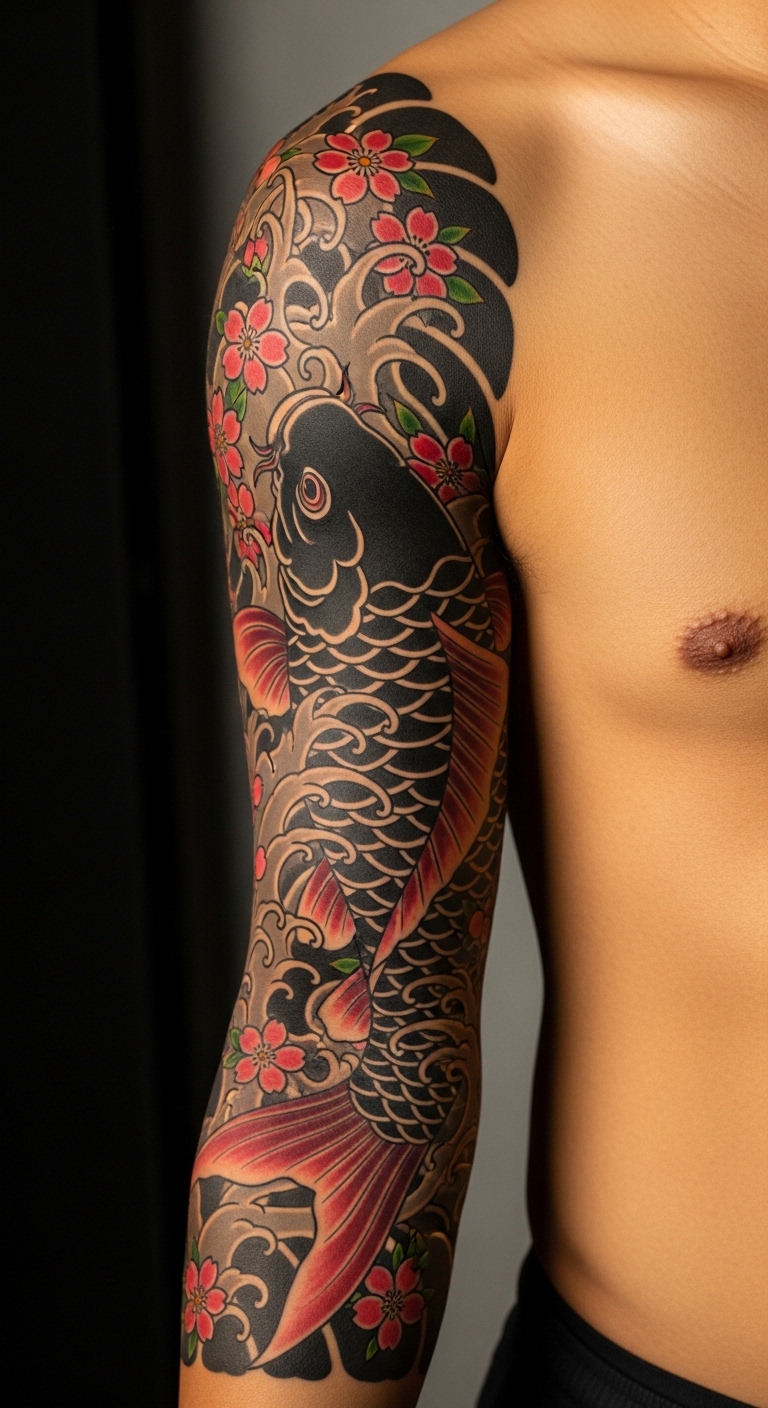
A koi fish sleeve executed in classic Japanese irezumi style transforms the entire arm into a living narrative of perseverance, fortune, and transformational courage. The koi swims powerfully upward through hand-rendered water waves, flanked by cherry blossom petals that drift across the composition with natural, flowing grace. Moreover, koi fish symbolism carries deep roots in Japanese culture — representing the determination to swim against powerful currents and emerge stronger on the other side. Additionally, full sleeve placement maximizes the storytelling potential of this epic design. Furthermore, traditional Japanese tattoo ideas built around koi fish consistently rank among the most requested sleeve compositions worldwide.
- Koi symbolizes perseverance and great fortune
- Cherry blossoms add seasonal beauty naturally
- Full sleeve tells a complete visual story
- Bold irezumi shading creates rich depth
- Upward koi direction signals active transformation
Full koi fish sleeve tattoos require serious commitment — typically 15 to 25 hours of total session time spread across 4 to 8 appointments spaced 6 weeks apart for proper healing between additions. Therefore, approaching this design as a long-term artistic investment rather than a quick single session produces dramatically superior results. Furthermore, traditional Japanese sleeve work demands an artist with deep irezumi training because the wave patterns, petal placements, and koi body shading all follow specific compositional conventions developed over centuries of Japanese tattoo tradition. Additionally, koi sleeve tattoos continue driving extraordinary Pinterest engagement in 2026 among collectors who want epic, story-driven body art. I’ve seen completed koi sleeves genuinely transform how collectors carry themselves with confidence daily.
Dragon Back Piece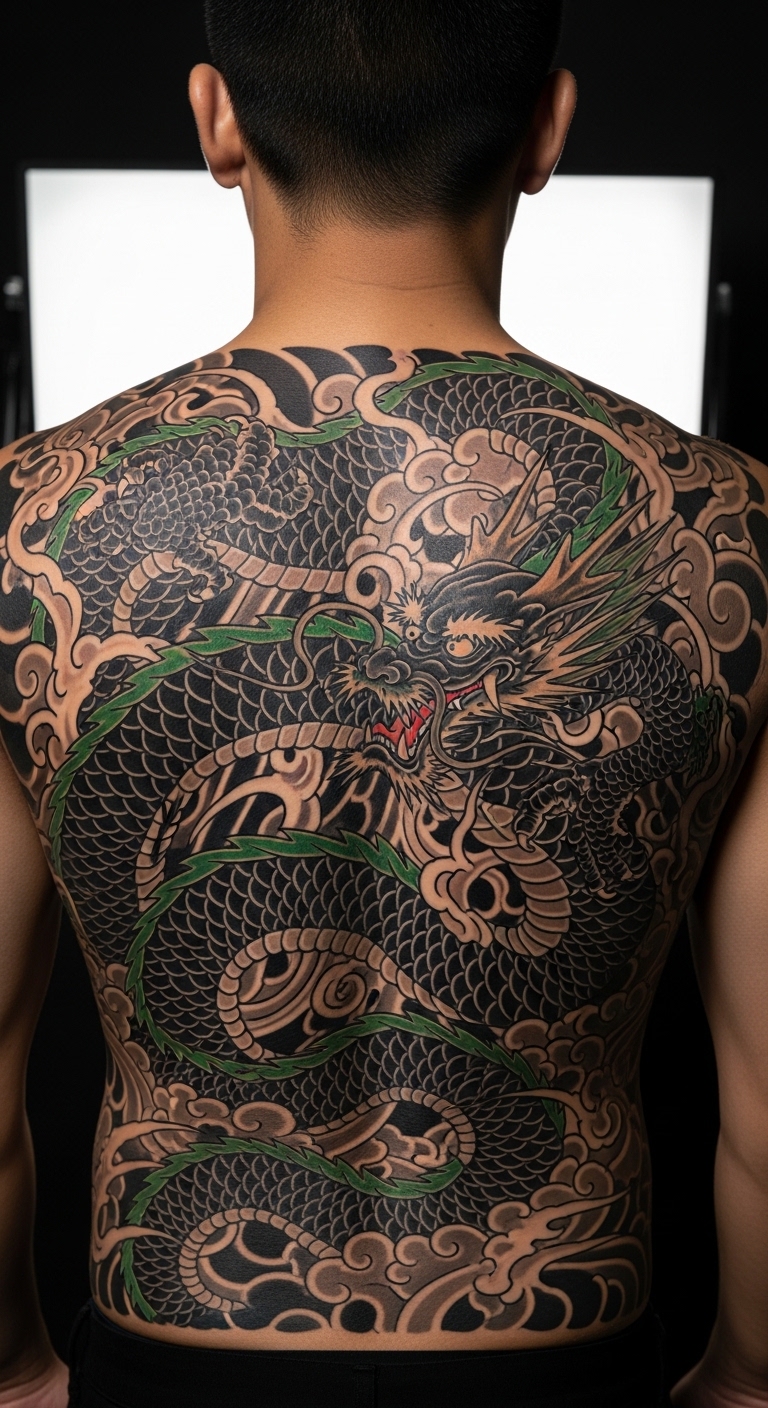
A Japanese ryū dragon coiling across the full back creates the most epic and symbolically powerful canvas in all of traditional Japanese body art. The dragon’s scaled body winds through cloud formations and stylized wind bars, creating a sense of dynamic movement that makes the entire back feel alive with mythological energy. Moreover, Japanese dragon symbolism carries extraordinary meaning around wisdom, protection, elemental power, and the benevolent force of nature expressed through a creature that commands both sky and sea. Additionally, full back placement gives the dragon’s serpentine body the maximum canvas required to display every scale, claw, and cloud formation with complete visual clarity. Furthermore, irezumi back pieces represent the pinnacle of Japanese tattoo artistry.
- Dragon symbolizes wisdom and elemental protection
- Full back canvas maximizes serpentine body detail
- Cloud formations add traditional atmospheric depth
- Irezumi shading creates dramatic scale contrast
- Back piece commands total room-commanding presence
Full back Japanese dragon tattoos represent some of the most technically demanding and time-intensive work in contemporary tattooing, typically requiring 25 to 40 hours across 6 to 12 sessions spread over 1 to 2 years. Therefore, selecting an artist with a verified portfolio of completed and healed Japanese back pieces — not just fresh work photos — protects the quality of your long-term result significantly. Furthermore, back tattoos heal smoothly when collectors sleep on their stomach during healing periods and wear loose cotton tops that prevent fabric friction across fresh dragon scale linework. Additionally, Japanese dragon back pieces generate exceptional Pinterest engagement globally in 2026. I’ve seen these epic back compositions completely redefine how collectors experience their own body as an artistic canvas.
Hannya Mask Chest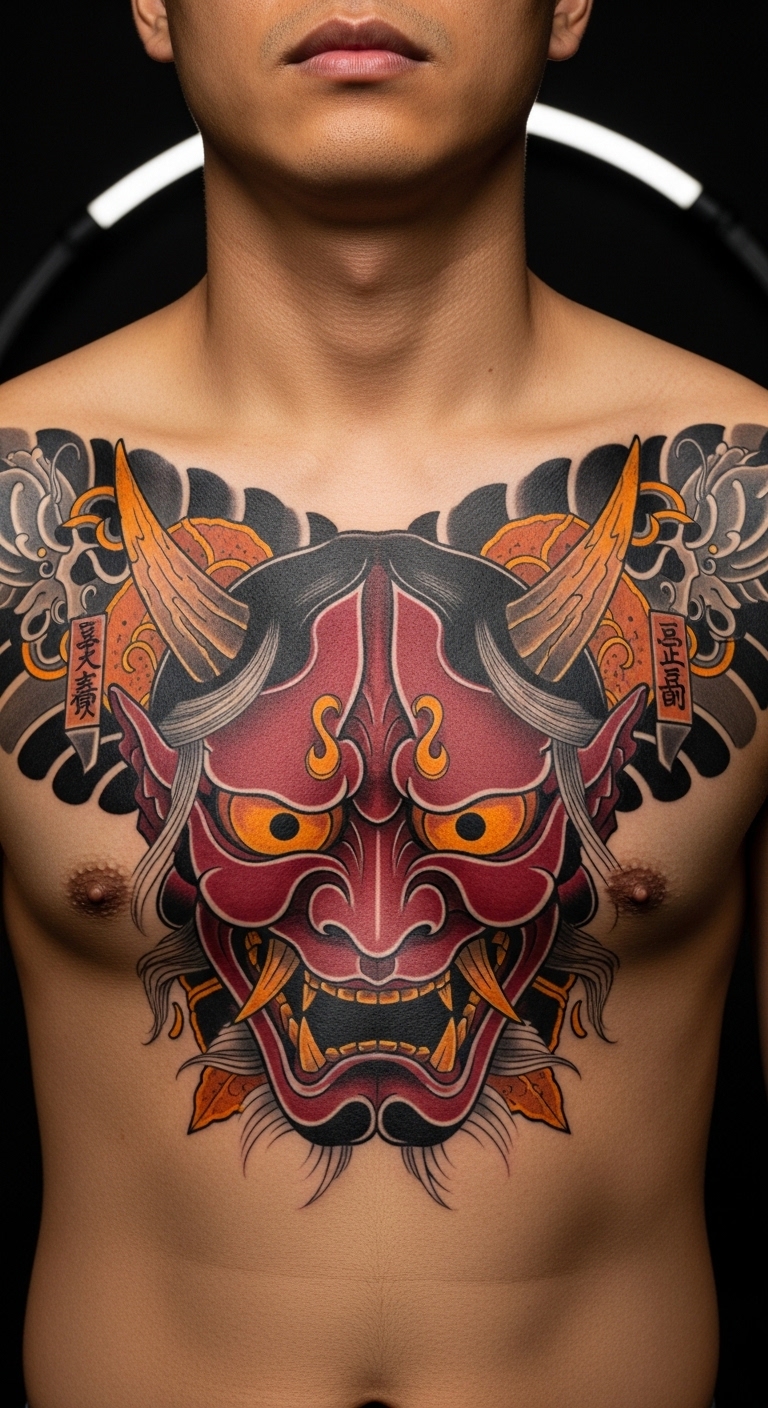
A Hannya mask placed at the center of the chest creates one of Japanese tattooing’s most emotionally charged and visually striking compositions. The mask’s fierce expression — sharp horns curling upward, piercing golden eyes, and a wide mouth revealing sharp teeth — communicates a depth of feeling that few other tattoo subjects can match in pure visual intensity. Moreover, Hannya symbolism carries complex meaning in Japanese tradition — representing a woman consumed by jealousy and grief who transforms into a demon, but also serving as a protective talisman against evil spirits. Additionally, chest placement centers this powerful mask over the heart, amplifying its emotional and protective symbolism simultaneously. Furthermore, Hannya mask tattoo ideas attract deeply intentional collectors.
- Hannya symbolizes intense emotion and protection
- Chest placement amplifies protective mask energy
- Red and black contrast creates dramatic impact
- Traditional irezumi details honor Japanese artistry
- Fierce expression commands immediate emotional attention
Hannya mask chest tattoos require an artist with deep knowledge of traditional Japanese mask imagery because the Hannya’s specific facial proportions — horn placement, eye shape, mouth width — follow iconographic conventions established in Japanese Noh theater tradition over 600 years ago. Therefore, working with an irezumi-specialized artist who understands Hannya mask iconography ensures your chest piece honors the design’s cultural and artistic heritage authentically. Furthermore, chest tattoos heal cleanly when loose, soft clothing drapes away from fresh linework during the 2-week recovery period. Additionally, Hannya mask chest tattoos continue driving strong Pinterest engagement in 2026, particularly among collectors who want powerful emotional symbolism expressed through traditional Japanese artistic conventions and bold, dramatic ink work.
Oni Demon Shoulder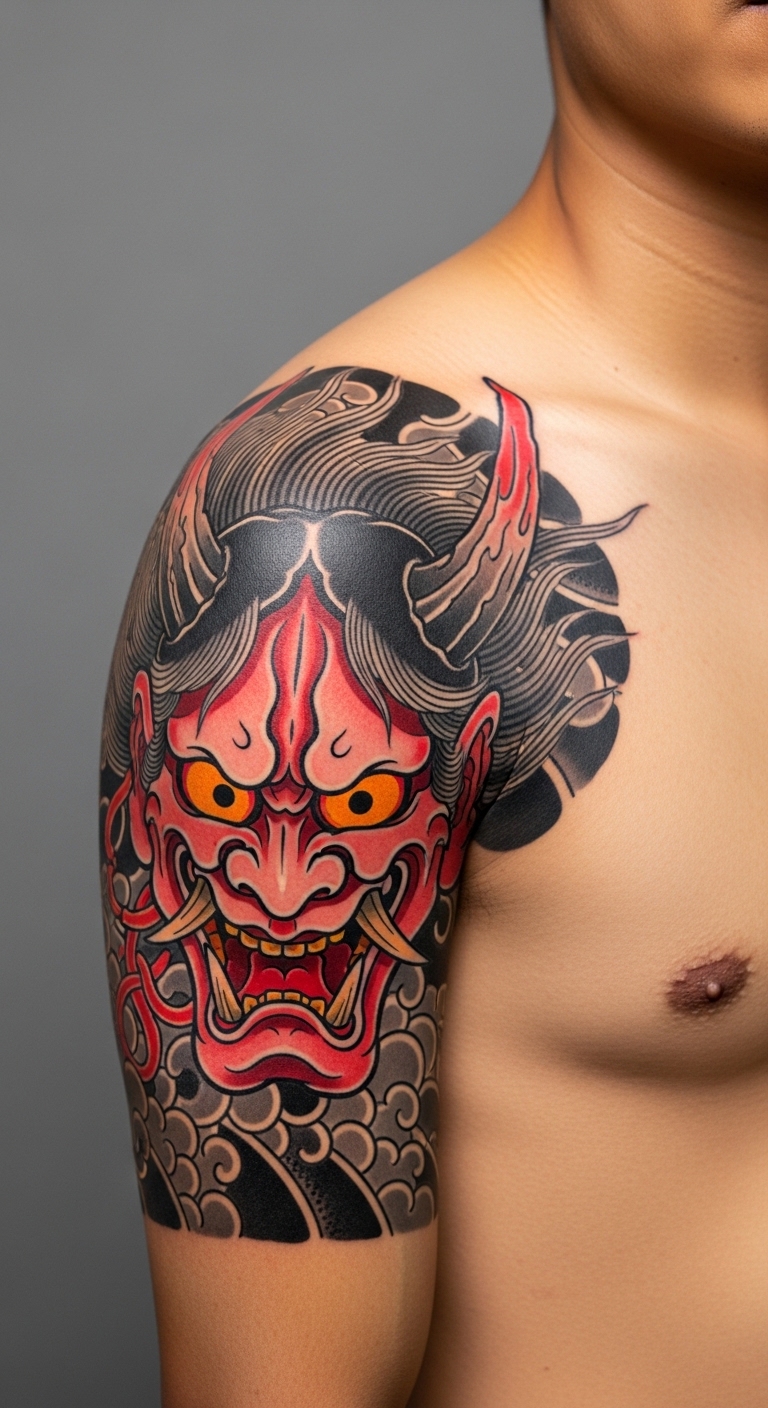
An Oni demon tattooed across the shoulder and upper arm delivers one of traditional Japanese folklore’s most fearsome and visually commanding subjects in a placement that suits the design’s bold, aggressive energy perfectly. The Oni’s wild hair, sharp tusks, and fierce red expression read with immediate power from across the room, creating a tattoo that communicates strength, fearlessness, and deep cultural knowledge simultaneously. Moreover, Oni symbolism in Japanese tradition carries nuanced meaning — these supernatural demons both cause misfortune and punish the wicked, making the Oni a complex symbol of justice, raw power, and the darker forces that maintain cosmic balance. Additionally, shoulder placement frames the Oni’s large head and expression with natural muscle architecture.
- Oni symbolizes raw power and cosmic justice
- Shoulder placement frames fierce expression powerfully
- Wild hair and tusks demand bold irezumi shading
- Red and black palette maximizes dramatic impact
- Japanese folklore depth attracts culturally aware collectors
Shoulder Oni tattoos require an artist who understands traditional Japanese demon iconography because the Oni’s specific visual elements — tusk size, horn placement, wild hair volume, and cloud detailing — follow artistic conventions developed across centuries of Japanese woodblock print and tattoo traditions. Therefore, reviewing your artist’s specifically completed Oni and Japanese demon portfolio before booking ensures they work within authentic irezumi compositional traditions rather than creating a generic demon portrait that lacks cultural grounding. Furthermore, outer shoulder tattoos heal smoothly because clothing drapes loosely over this surface without consistent pressure. Additionally, Oni demon shoulder tattoos continue performing strongly across Pinterest Japanese tattoo boards in 2026 among collectors who want bold cultural symbolism executed with genuine artistic authority.
Phoenix Rising Back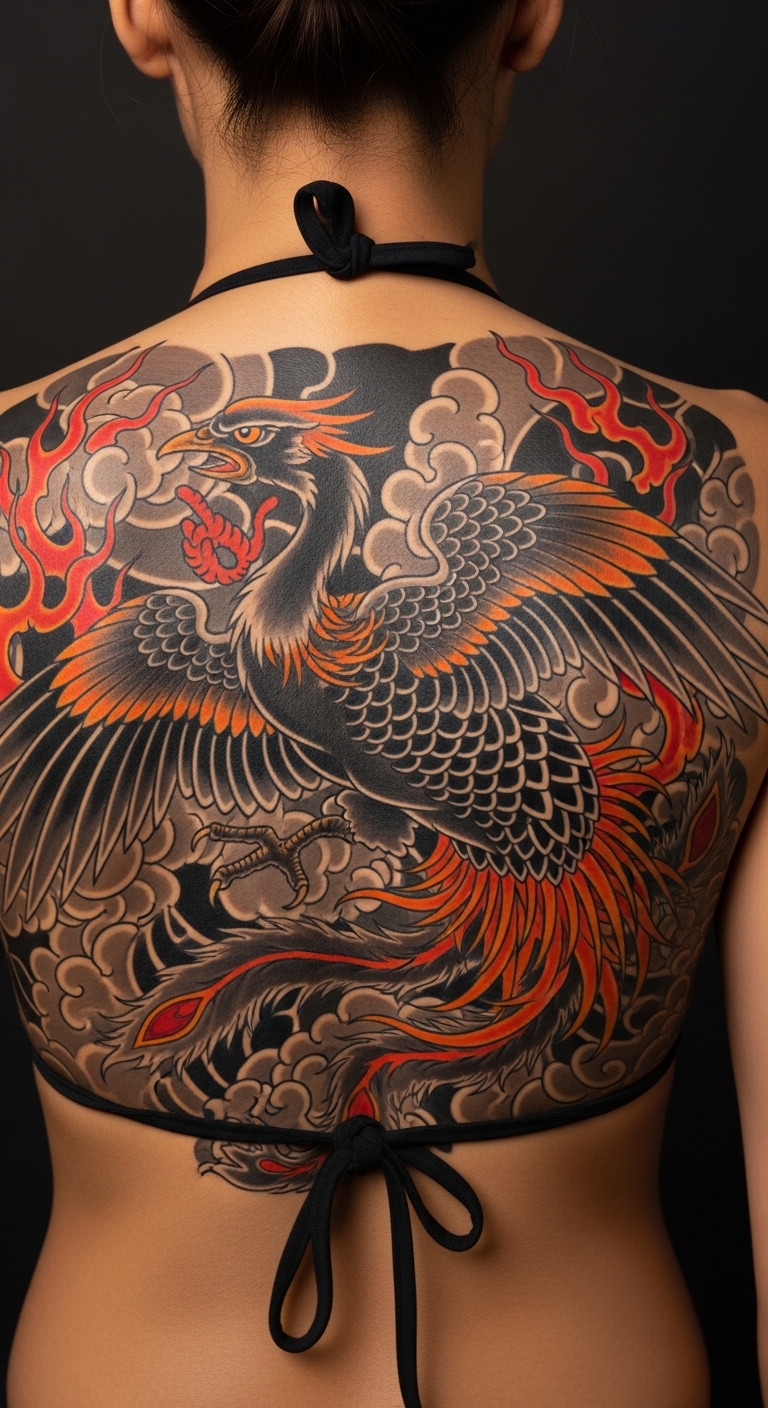
A Japanese hō-ō phoenix spreading its wings across the full upper back creates one of the most breathtaking and symbolically profound back tattoo compositions in all of Japanese irezumi tradition. The phoenix’s dramatic wing span fills the upper back completely with flowing feather detail, bold color saturation, and the dynamic energy of stylized flames rising beneath each wing. Moreover, Japanese phoenix symbolism carries extraordinary meaning around rebirth, resilience, the triumph of renewal over destruction, and the perpetual cycle of transformation that defines every meaningful life journey. Additionally, the upper back provides the ideal horizontal canvas for a full wing span that needs room to breathe. Furthermore, Japanese phoenix back tattoos suit collectors who have overcome significant personal challenges.
- Phoenix symbolizes rebirth and triumphant renewal
- Full wing span needs upper back canvas
- Flame detailing adds dynamic upward movement
- Orange and red palette creates visual fire
- Powerful symbolism resonates with transformation collectors
Upper back Japanese phoenix tattoos require an artist who understands hō-ō iconography specifically because the Japanese phoenix differs significantly from Western phoenix imagery — the hō-ō features elaborate tail feathers, specific crest formations, and flame cloud combinations that follow Japanese artistic conventions developed across centuries of decorative art tradition. Therefore, sharing reference images of authentic Japanese hō-ō artwork — from woodblock prints, lacquerware, and established irezumi photography — with your artist during consultation ensures the phoenix honors its Japanese visual heritage. Furthermore, upper back tattoos heal cleanly when collectors wear loose tops during recovery. I’ve seen Japanese phoenix back pieces generate some of the most powerful emotional responses from collectors who chose them to mark profound personal transformations.
Tiger Forearm Wrap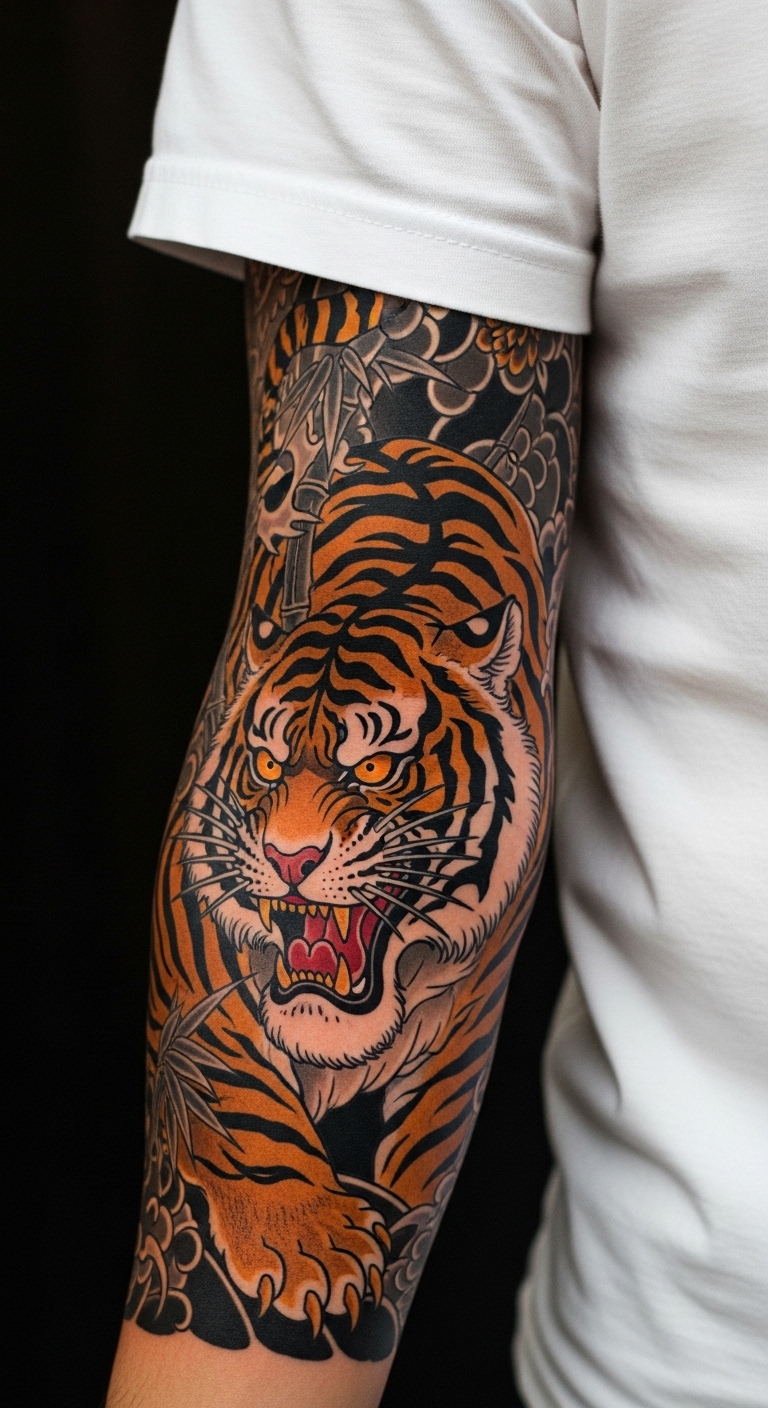
A Japanese tiger wrapping around the forearm in classic irezumi style creates a tattoo that radiates fierce protective energy and bold visual impact with every arm movement. The tiger’s striped body follows the forearm’s natural cylindrical shape, coiling around the arm in a way that creates dynamic visual tension between the cat’s powerful form and the bamboo background elements framing the composition. Moreover, Japanese tiger symbolism carries profound meaning around courage, wind, protection against evil, and the fierce strength that comes from embodying one’s natural power without restraint or apology. Additionally, forearm placement makes the tiger visible during every interaction throughout the day. Furthermore, traditional Japanese tattoo ideas featuring tigers consistently rank among the most searched irezumi designs globally.
- Tiger symbolizes courage and fierce protection
- Stripes follow forearm cylinder shape naturally
- Bamboo background adds authentic Japanese context
- Amber and black palette creates bold drama
- Forearm placement maximizes daily visual impact
Forearm Japanese tiger tattoos require an artist with strong irezumi training because the tiger’s striping pattern, facial expression, and bamboo background detailing must follow Japanese artistic conventions that differ fundamentally from Western realistic tiger portraiture. Furthermore, the forearm’s cylindrical surface means the tiger’s body wraps around the arm continuously, requiring the artist to plan how the design reads from multiple viewing angles simultaneously rather than designing for a single flat perspective. Therefore, requesting a full wrap stencil preview that accounts for all viewing angles before beginning protects the compositional quality of the final result. Additionally, Japanese tiger forearm tattoos continue driving strong Pinterest engagement in 2026 among collectors aged 21 to 32 who want bold, culturally authentic body art with genuine symbolic power behind every design element.
Chrysanthemum Sleeve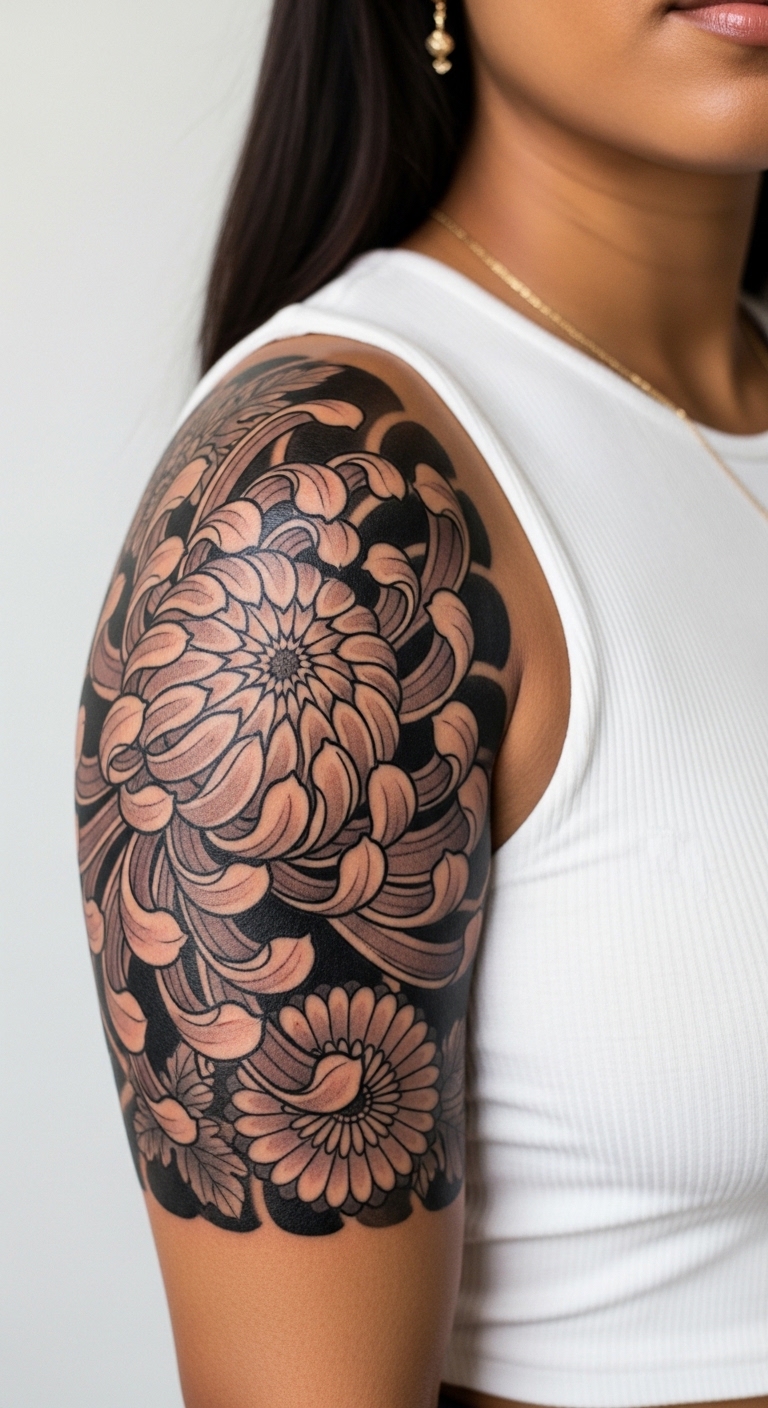
A Japanese chrysanthemum sleeve filling the upper arm with layered petal formations and traditional irezumi composition creates one of the most elegant and culturally rich floral tattoo styles available in Japanese body art. The chrysanthemum’s densely layered petals create extraordinary visual texture, with each petal curve rendered with the precise, confident brushwork that defines authentic Japanese floral tattooing at its finest. Moreover, chrysanthemum symbolism holds the highest cultural status in Japanese tradition — the flower represents the imperial family, longevity, rejuvenation, and the noble beauty of a life lived with integrity and grace. Additionally, upper arm placement provides an ideal sleeve canvas for chrysanthemum compositions that need vertical space to stack multiple flower heads naturally. Furthermore, Japanese floral sleeve tattoos suit feminine aesthetics beautifully.
- Chrysanthemum symbolizes imperial nobility and longevity
- Layered petals create extraordinary visual texture
- Upper arm sleeve suits vertical floral stacking
- Traditional irezumi composition honors Japanese artistry
- Elegant floral style suits feminine collectors perfectly
Upper arm chrysanthemum sleeve tattoos require an artist who understands the specific petal rendering techniques used in traditional Japanese floral tattooing — the bold confident outlines, the graduated gray wash shading within each petal curve, and the compositional balance between flower heads and negative space that gives irezumi floral work its characteristic visual dignity. Therefore, studying your chosen artist’s specifically completed Japanese floral sleeve work rather than their general portfolio ensures they possess the specialized botanical knowledge this style demands. Furthermore, upper arm tattoos heal predictably well because dense muscle tissue provides reliable ink retention. Additionally, Japanese chrysanthemum sleeve tattoos continue generating strong Pinterest saves in 2026, particularly within feminine irezumi communities that celebrate the intersection of cultural depth and natural beauty.
Samurai Warrior Back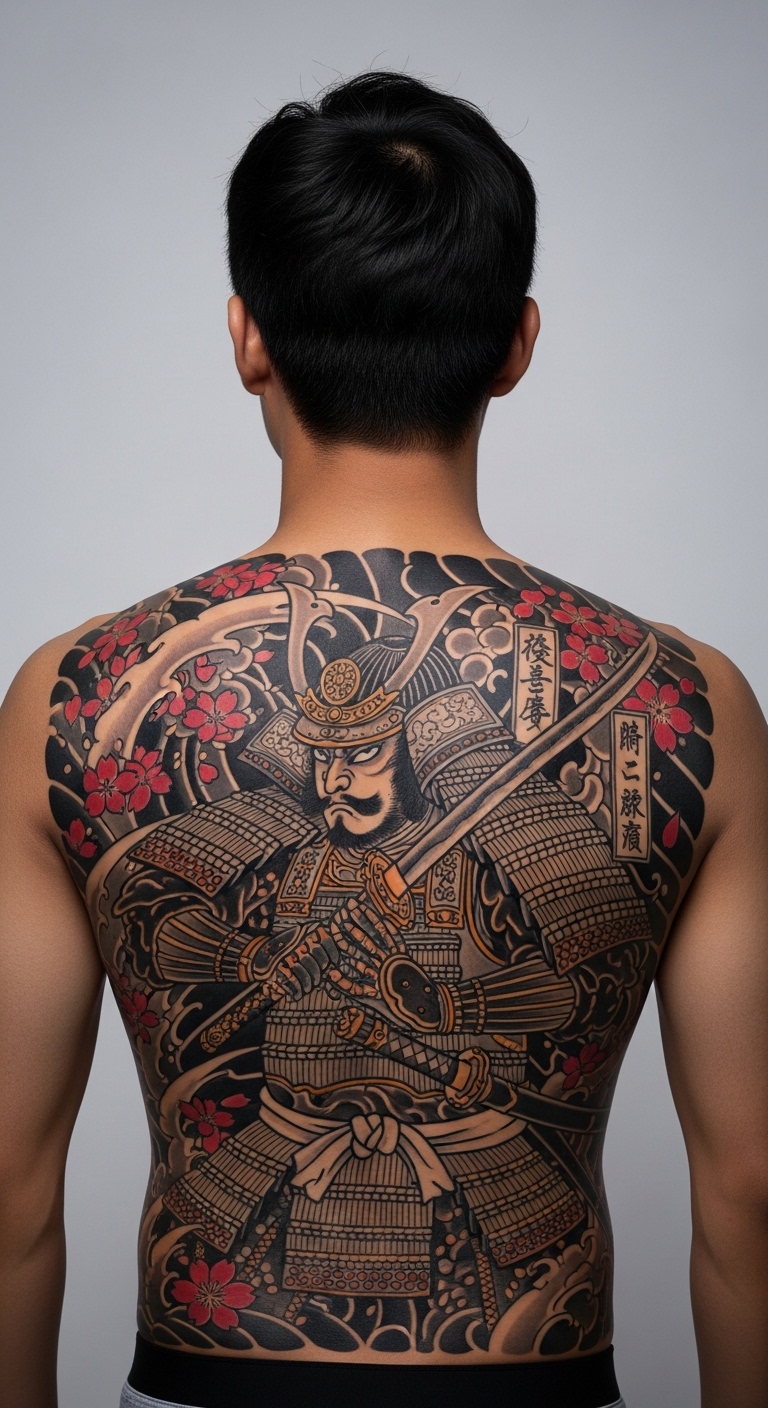
A full samurai warrior in complete armor depicted across the back creates the most narratively complex and culturally reverent subject in all of traditional Japanese back piece tattooing. The samurai’s detailed armor plates, drawn katana, and fierce expression fill the back with a scene that reads like a living woodblock print permanently embedded into skin. Moreover, samurai symbolism carries extraordinary meaning around bushido — the warrior code of honor, loyalty, discipline, and the willingness to sacrifice personal comfort for a higher moral purpose. Additionally, cherry blossom elements surrounding the samurai figure add the bittersweet beauty of impermanence, reinforcing the samurai’s philosophical acceptance of mortality as life’s greatest teacher. Furthermore, this epic Japanese tattoo idea suits the most dedicated collectors.
- Samurai symbolizes bushido honor and discipline
- Full armor detail demands exceptional artist mastery
- Cherry blossoms add impermanence philosophical depth
- Back canvas allows complete narrative scene
- Living woodblock print energy feels culturally epic
Full samurai back tattoos represent the highest level of Japanese irezumi commitment, typically requiring 30 to 50 hours across 8 to 15 sessions spanning 1.5 to 3 years of dedicated appointments with the same artist throughout. Therefore, establishing a strong, trusting relationship with your chosen irezumi artist before beginning a samurai back piece ensures the design develops with consistent artistic vision across every session. Furthermore, the samurai’s armor detail, facial expression, and wind bar framing elements must all follow authentic Japanese artistic conventions established in Edo period woodblock print traditions. Additionally, samurai back tattoos generate extraordinary Pinterest engagement globally in 2026. I’ve seen completed samurai back pieces described by their collectors as the single most transformative and deeply personal artistic experience of their lives.
Peony Thigh Piece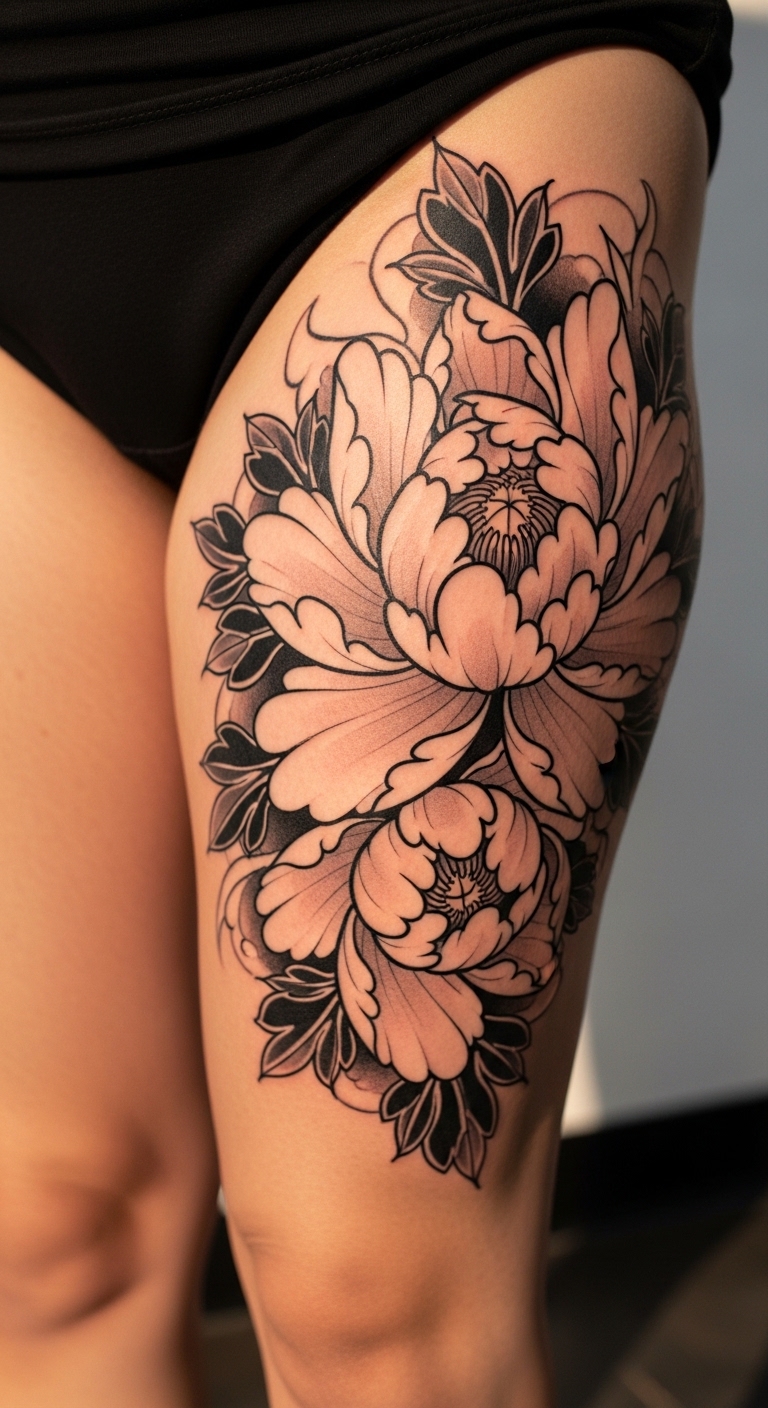
A Japanese botan peony filling the outer thigh with large layered petals and traditional irezumi leaf detailing creates a tattoo that transforms one of Japan’s most beloved flowers into a bold, sensual statement piece. The peony’s massive petal formations spread across the thigh canvas with the kind of confident visual weight that only large-scale Japanese floral work can achieve. Moreover, Japanese peony symbolism carries deep meaning around bravery, good fortune, honor, and the bold beauty of a person who faces life’s challenges with dignity and genuine courage. Additionally, the outer thigh provides a large, relatively flat canvas that suits the peony’s generous proportions perfectly without compression. Furthermore, Japanese peony thigh tattoos suit collectors who want powerful floral body art in a private placement.
- Peony symbolizes bravery and bold good fortune
- Large petals need the full thigh canvas
- Traditional irezumi leaf detailing adds authenticity
- Private placement reveals dramatically in summer
- Bold floral energy suits confident collectors perfectly
Outer thigh Japanese peony tattoos heal smoothly because loose clothing sits away from the thigh surface without applying consistent friction against fresh petal linework during normal daily movement. Furthermore, the generous peony petal formations require an artist with strong irezumi floral training because each petal curve must be rendered with bold confident outlines and graduated gray wash shading that follows the petal’s natural three-dimensional form convincingly. Therefore, reviewing your artist’s completed and healed Japanese peony work specifically — rather than general floral portfolio pieces — ensures they understand the botan’s specific proportional requirements within traditional Japanese compositional conventions. Additionally, Japanese peony thigh tattoos continue generating strong Pinterest saves in 2026 particularly within feminine irezumi communities that celebrate large-scale Japanese floral body art.
Kirin Mythical Creature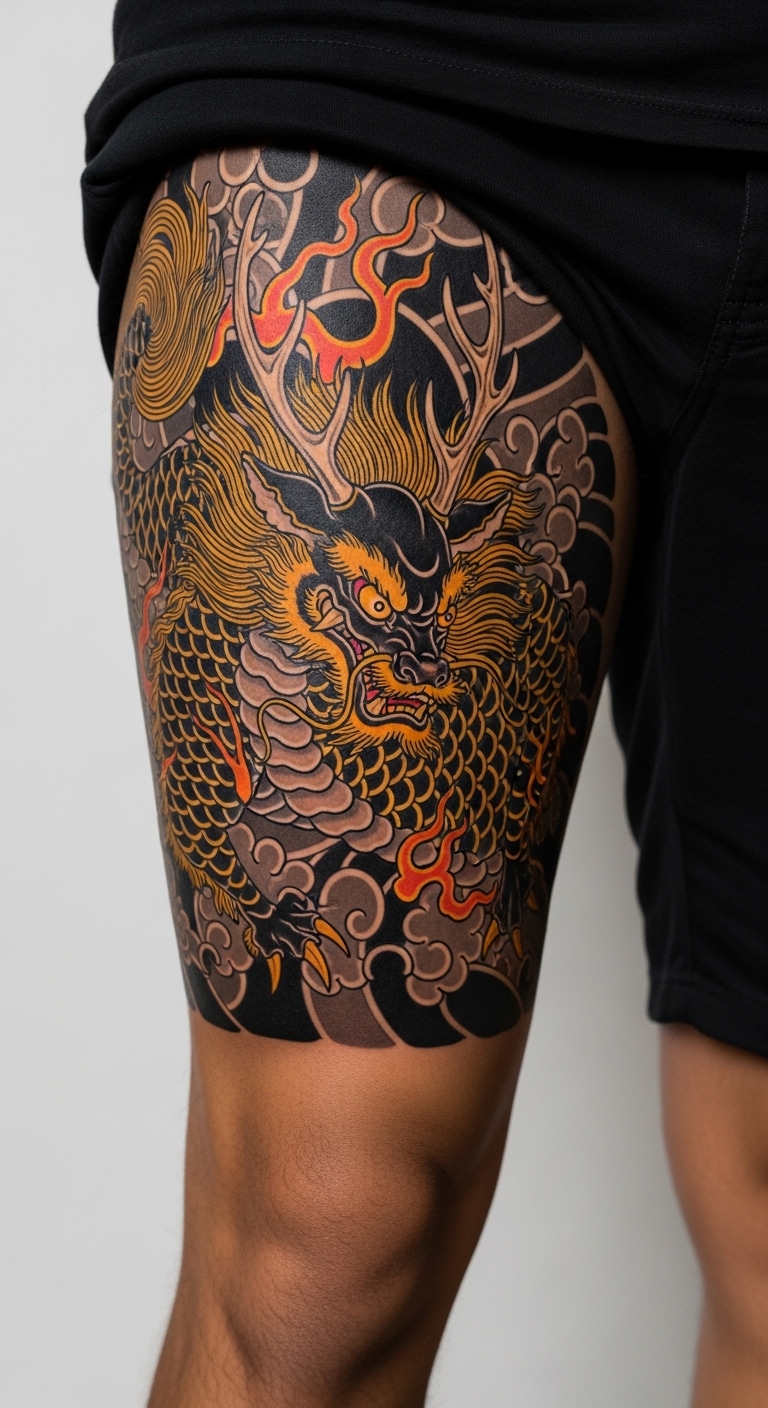
A Japanese kirin depicted across the outer thigh creates one of the rarest and most culturally distinguished subject choices in all of traditional Japanese irezumi tattooing. The kirin’s extraordinary hybrid form — scaled dragon body, flowing celestial mane, deer antlers, and hooves surrounded by sacred flames — creates a composition of mythological complexity that rewards extended viewing with constantly revealing new details. Moreover, kirin symbolism carries the highest positive meaning in Japanese folklore, representing good omens, the arrival of a wise and benevolent ruler, and the rare appearance of extraordinary virtue in the world. Additionally, thigh placement gives the kirin’s elaborate hybrid body the generous canvas it needs to display every mythological element clearly. Furthermore, Japanese mythical creature tattoo ideas attract the most culturally knowledgeable collectors.
- Kirin symbolizes supreme good fortune and virtue
- Hybrid body needs generous thigh canvas
- Flames and clouds add celestial authenticity
- Rarest irezumi subject shows deep cultural knowledge
- Gold and black palette creates mythological drama
Outer thigh kirin tattoos require an artist with comprehensive knowledge of Japanese mythological iconography because the kirin’s specific visual elements — scale pattern, mane style, antler formation, and flame cloud placement — follow artistic conventions established across centuries of Japanese decorative art, lacquerware, and woodblock print traditions. Therefore, sharing authenticated reference images of traditional kirin artwork with your artist during consultation ensures the design honors its mythological heritage with genuine accuracy. Furthermore, thigh placement heals smoothly with loose clothing protecting the fresh linework from daily friction. Additionally, Japanese kirin tattoos generate exceptional Pinterest engagement among collectors who actively research Japanese mythology before choosing their designs. I’ve noticed kirin tattoos consistently attract the most intellectually curious and culturally engaged collector communities in irezumi tattooing today.
Wave Shoulder Cap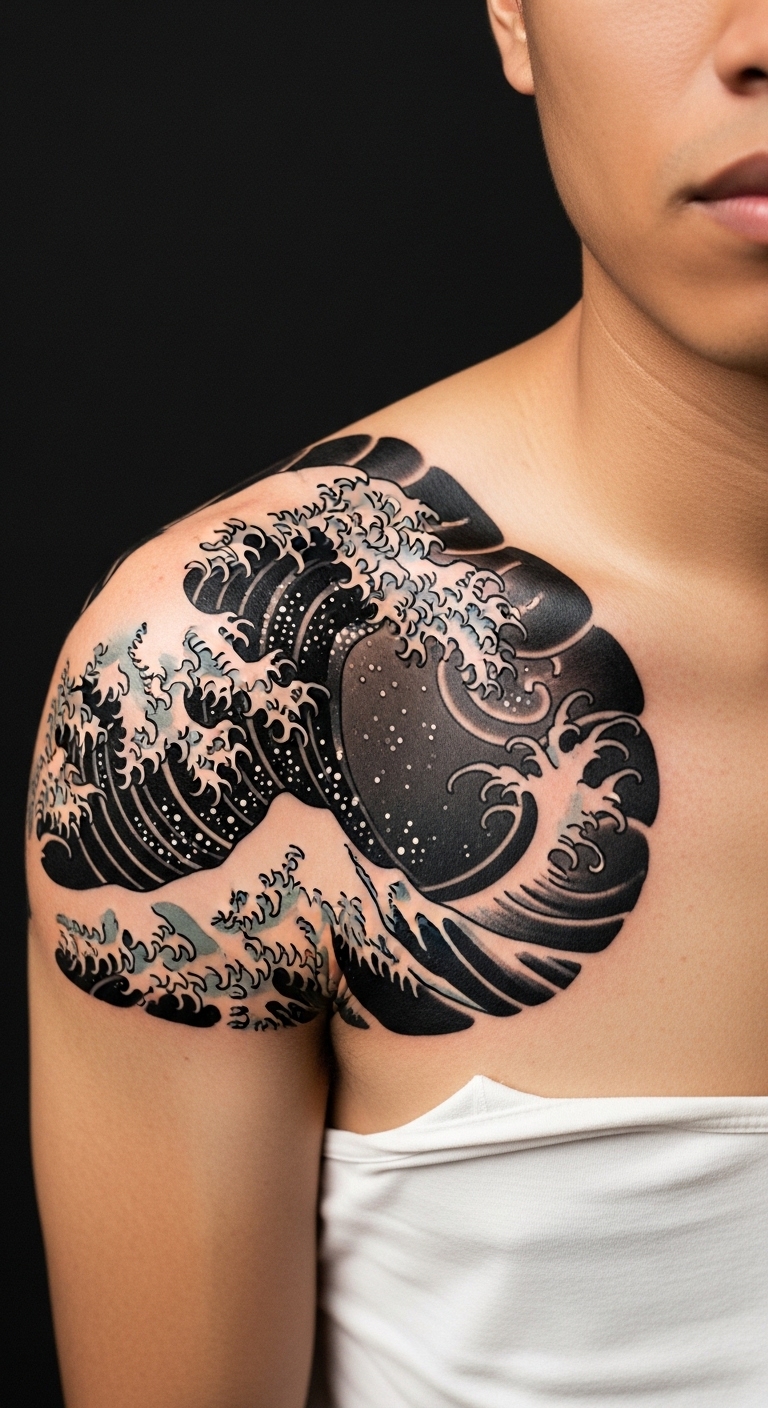
A Hokusai-inspired Japanese wave wrapping over the shoulder cap creates a tattoo that channels the most iconic image in all of Japanese visual art directly onto the body with dramatic, rolling energy. The stylized wave crests curl with bold white foam highlights above deep indigo water bodies, creating a composition that feels perpetually in motion even on completely still skin. Moreover, Japanese wave symbolism carries meaning around overwhelming natural power, the beauty of forces beyond human control, and the meditative acceptance of life’s constant, unpredictable movement. Additionally, shoulder cap placement follows the natural rounded curve of the shoulder, allowing the wave to wrap organically over the body’s own architecture. Furthermore, traditional Japanese water tattoo ideas remain among the most searched irezumi designs globally in 2026.
- Hokusai wave channels iconic Japanese visual art
- Shoulder cap curve suits wave wrapping naturally
- White foam crests create dramatic visual contrast
- Ocean power symbolism resonates universally and deeply
- Bold irezumi waves generate extraordinary visual movement
Shoulder cap Japanese wave tattoos require an artist with strong Hokusai-style water rendering skills because the specific curl pattern of Japanese stylized waves — the precise foam crest shapes, the graduated depth shading within each water body, and the dynamic tension between crest and trough — follow artistic conventions that differ fundamentally from realistic ocean wave illustration. Therefore, artists who specifically reference Edo period Japanese woodblock print water techniques produce dramatically more authentic results than generalists attempting Japanese wave work without deep stylistic research. Furthermore, shoulder cap tattoos heal smoothly with loose top clothing draping away from fresh linework. Additionally, Japanese wave shoulder tattoos continue driving strong Pinterest performance in 2026. I’ve seen this design resonate powerfully with collectors who have a deep personal connection to ocean environments.
Snake And Peony Arm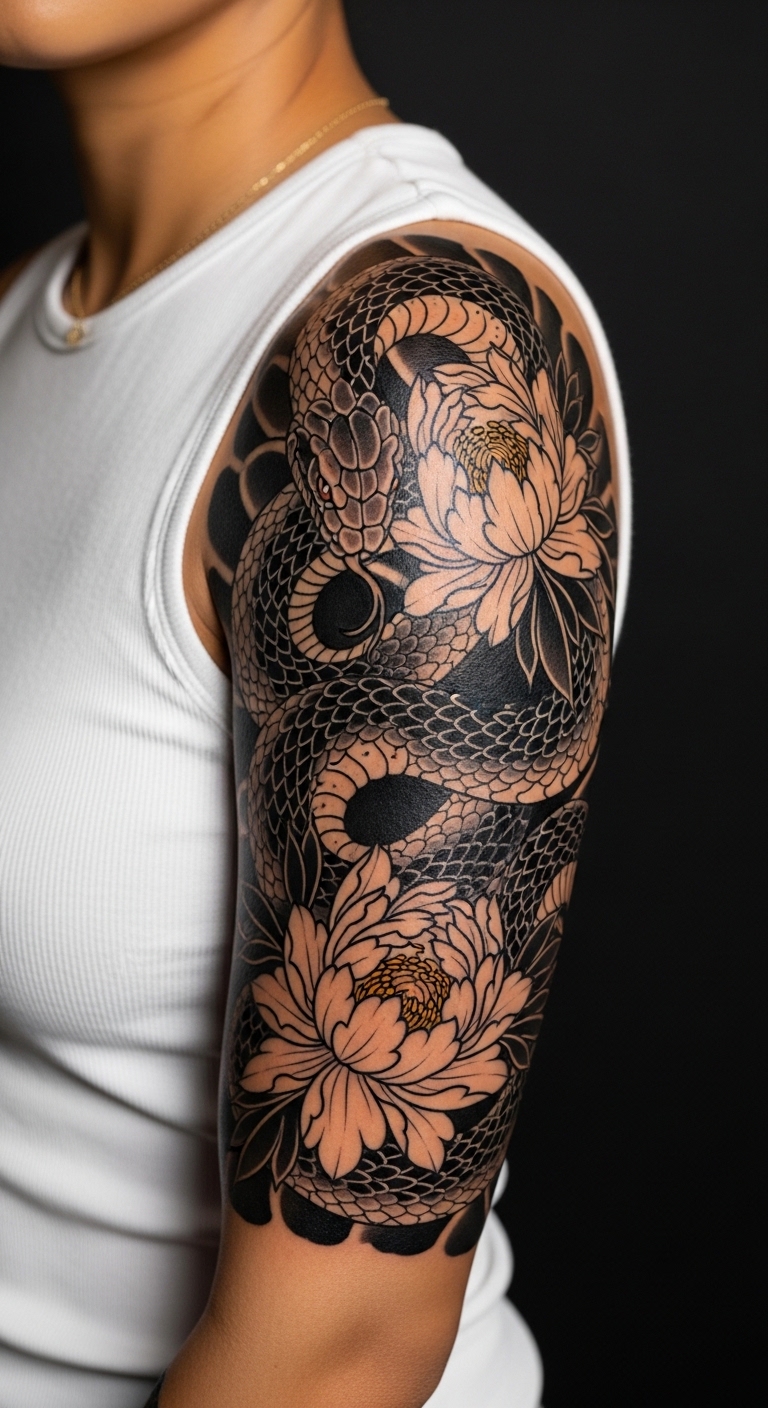
A Japanese hebi snake coiling through bold botan peony flowers on the upper arm creates one of traditional irezumi’s most visually balanced and symbolically layered compositional pairings. The snake’s sinuous body weaves between the peony’s generous petal formations, creating a dynamic tension between the flower’s soft abundance and the serpent’s focused, purposeful movement. Moreover, the pairing of snake and peony in Japanese tattoo tradition carries rich symbolic meaning — the snake represents transformation, wisdom, and protective instinct while the peony adds bravery, good fortune, and the bold beauty of life fully embraced. Additionally, upper arm placement gives both the snake and peony elements room to interact without compositional crowding. Furthermore, Japanese snake tattoo ideas paired with floral elements perform strongly across irezumi Pinterest communities.
- Snake and peony create perfect symbolic balance
- Coiling body weaves through peony petals naturally
- Combined symbolism doubles meaningful depth powerfully
- Upper arm canvas suits dynamic paired compositions
- Traditional pairing honors centuries of irezumi convention
Upper arm Japanese snake and peony tattoos require an artist who understands the compositional relationship between the hebi and botan elements in traditional irezumi design — specifically how the snake’s body should move through the floral arrangement with visual purpose rather than simply overlapping the flowers without directional intention. Therefore, studying reference examples of authenticated traditional Japanese snake and peony sleeve work before your consultation helps you communicate the specific compositional dynamic you want your artist to achieve. Furthermore, upper arm tattoos heal reliably because dense muscle tissue holds irezumi linework and shading firmly during recovery. Additionally, Japanese snake and peony arm tattoos continue generating strong Pinterest engagement in 2026 among collectors who want complex, multi-element irezumi compositions with genuine cultural authenticity behind every design decision.
Foo Dog Chest Piece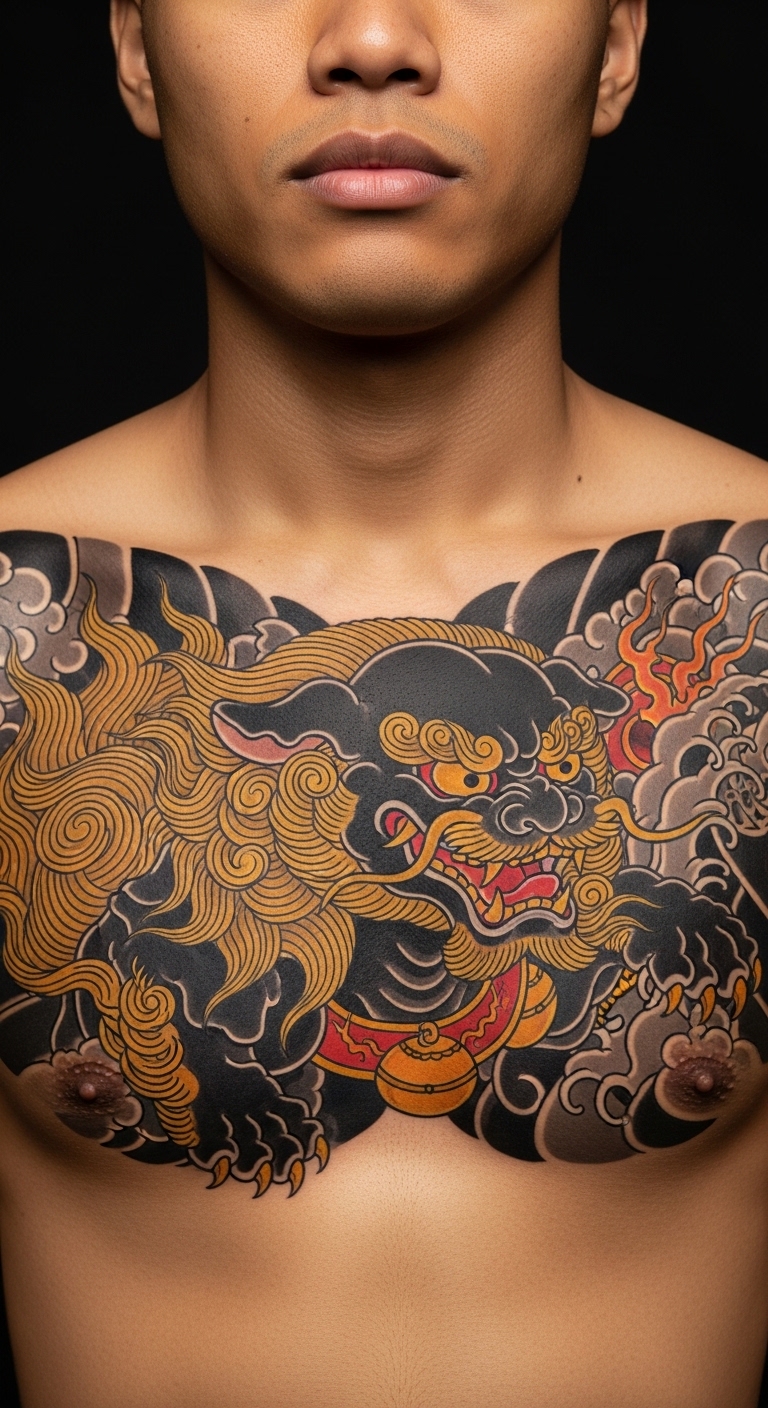
A Japanese shishi foo dog centered on the chest creates a protective guardian tattoo of extraordinary visual power and deep cultural significance rooted in centuries of Japanese temple and shrine architectural tradition. The foo dog’s fierce open-mouth expression, flowing curled mane, and muscular body communicate an unwavering protective force that collectors choose specifically to mark over the heart as a permanent guardian of their most vital organ. Moreover, shishi symbolism in Japanese tradition represents divine protection, the warding off of evil spirits, and the fierce, loyal guardianship of sacred spaces and the people who inhabit them. Additionally, chest placement directly over the heart amplifies the foo dog’s protective symbolism to its maximum emotional resonance. Furthermore, Japanese guardian tattoo ideas attract deeply intentional collectors globally.
- Shishi symbolizes divine protection and fierce guardianship
- Heart placement maximizes protective symbolic power
- Fierce expression wards off negative energy
- Gold and black palette creates guardian authority
- Temple guardian energy translates powerfully to skin
Chest foo dog tattoos require an artist with deep knowledge of Japanese shishi iconography because the foo dog’s specific visual elements — mane curl patterns, paw positioning, open mouth tooth structure, and cloud detailing — follow artistic conventions established in Japanese temple architecture, Noh theater props, and lacquerware decoration across hundreds of years of consistent cultural production. Therefore, working with an irezumi-specialized artist who has studied Japanese temple guardian imagery specifically ensures your chest piece carries genuine iconographic authenticity. Furthermore, chest tattoos heal cleanly with loose soft clothing during the 2-week recovery period. Additionally, Japanese foo dog chest tattoos continue performing strongly on Pinterest in 2026 among collectors who want culturally authentic protective body art with genuine historical depth.
Cherry Blossom Spine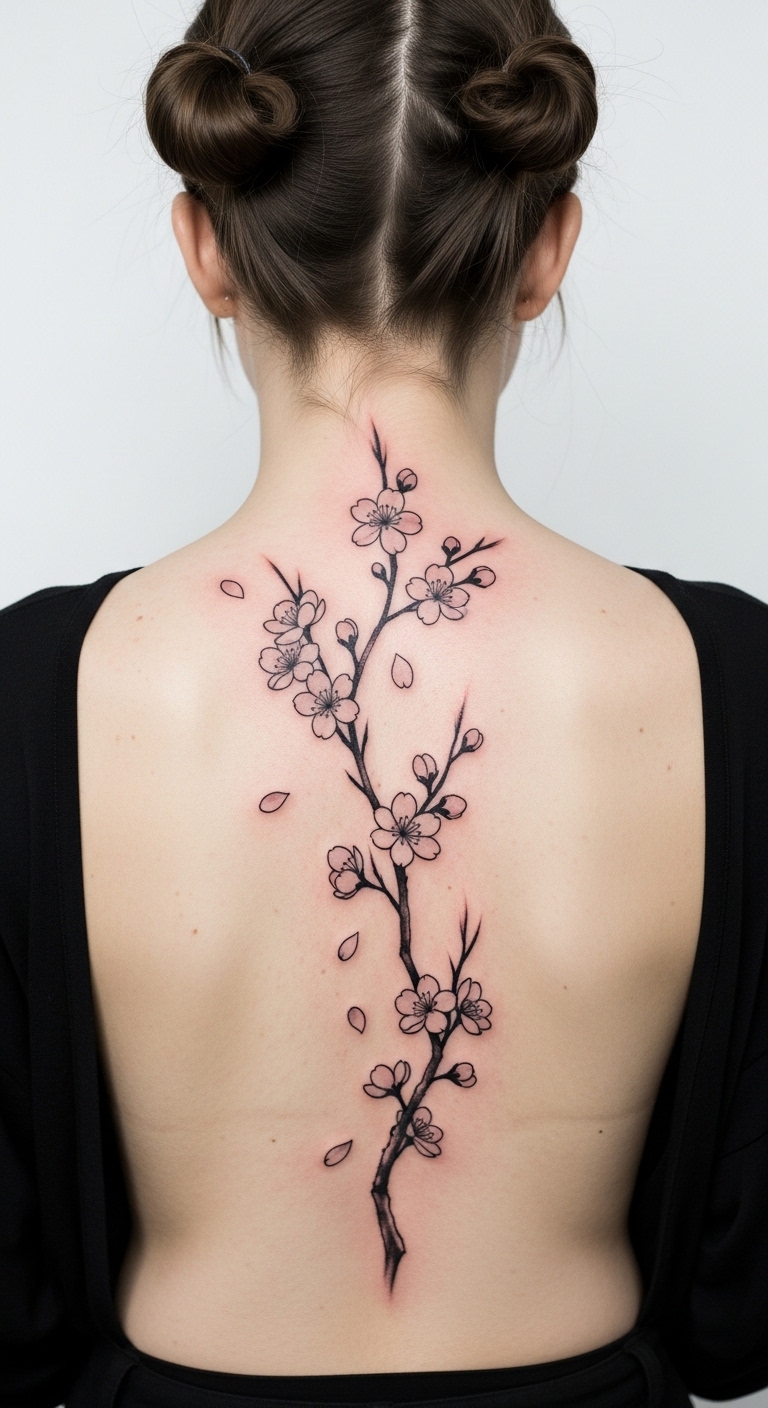
A Japanese sakura cherry blossom branch running vertically down the full spine creates one of the most poetic and visually graceful placements in all of Japanese floral tattooing. The branch follows the spine’s natural centerline with organic precision, while falling petals scatter softly around the central branch in a composition that feels simultaneously designed and naturally spontaneous. Moreover, cherry blossom symbolism holds profound meaning in Japanese philosophical tradition — mono no aware — the bittersweet beauty of impermanence, the profound appreciation of each moment precisely because every moment passes without return. Additionally, spine placement gives the vertical branch composition the full-length canvas it needs to breathe completely. Furthermore, Japanese cherry blossom tattoo ideas consistently rank among the most saved feminine irezumi designs on Pinterest globally.
- Sakura symbolizes beautiful, profound impermanence
- Spine centerline suits vertical branch naturally
- Falling petals create spontaneous organic movement
- Mono no aware philosophy runs emotionally deep
- Delicate gray wash keeps design elegantly feminine
Spine cherry blossom tattoos require an artist who understands the specific compositional principles of Japanese botanical illustration — how branches curve with natural tension, how petal clusters distribute with organic irregularity rather than uniform spacing, and how falling petals create visual momentum along the spine’s vertical axis. Therefore, reviewing your artist’s specifically completed Japanese botanical spine work ensures they approach the sakura branch with the botanical sensitivity this design demands. Furthermore, spine tattoos heal smoothly with loose breathable tops preventing fabric friction across the full branch length during recovery. Additionally, Japanese cherry blossom spine tattoos continue generating extraordinary Pinterest saves in 2026, particularly within feminine Japanese tattoo communities. I’ve seen this placement described by collectors as the most personally meaningful and visually rewarding tattoo decision of their lives.
Koi And Lotus Thigh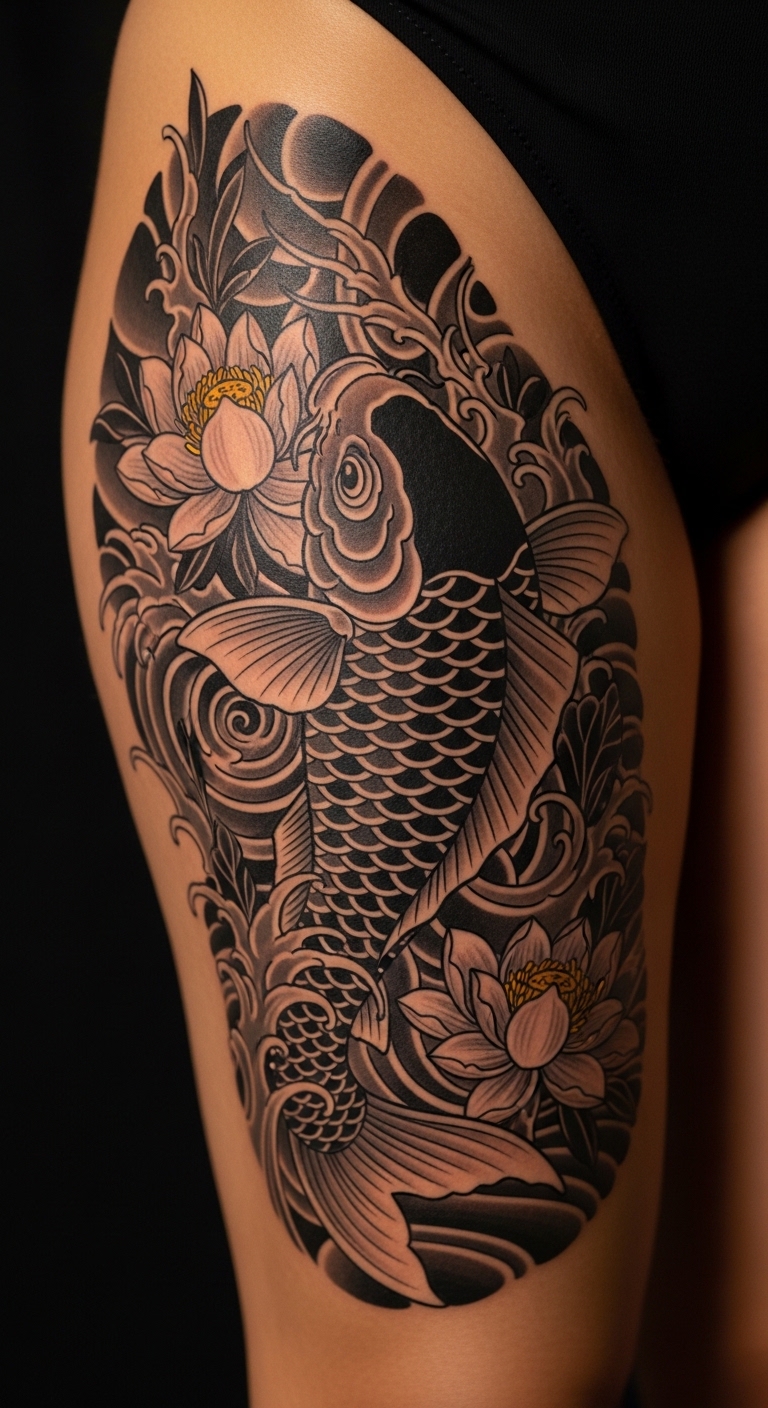
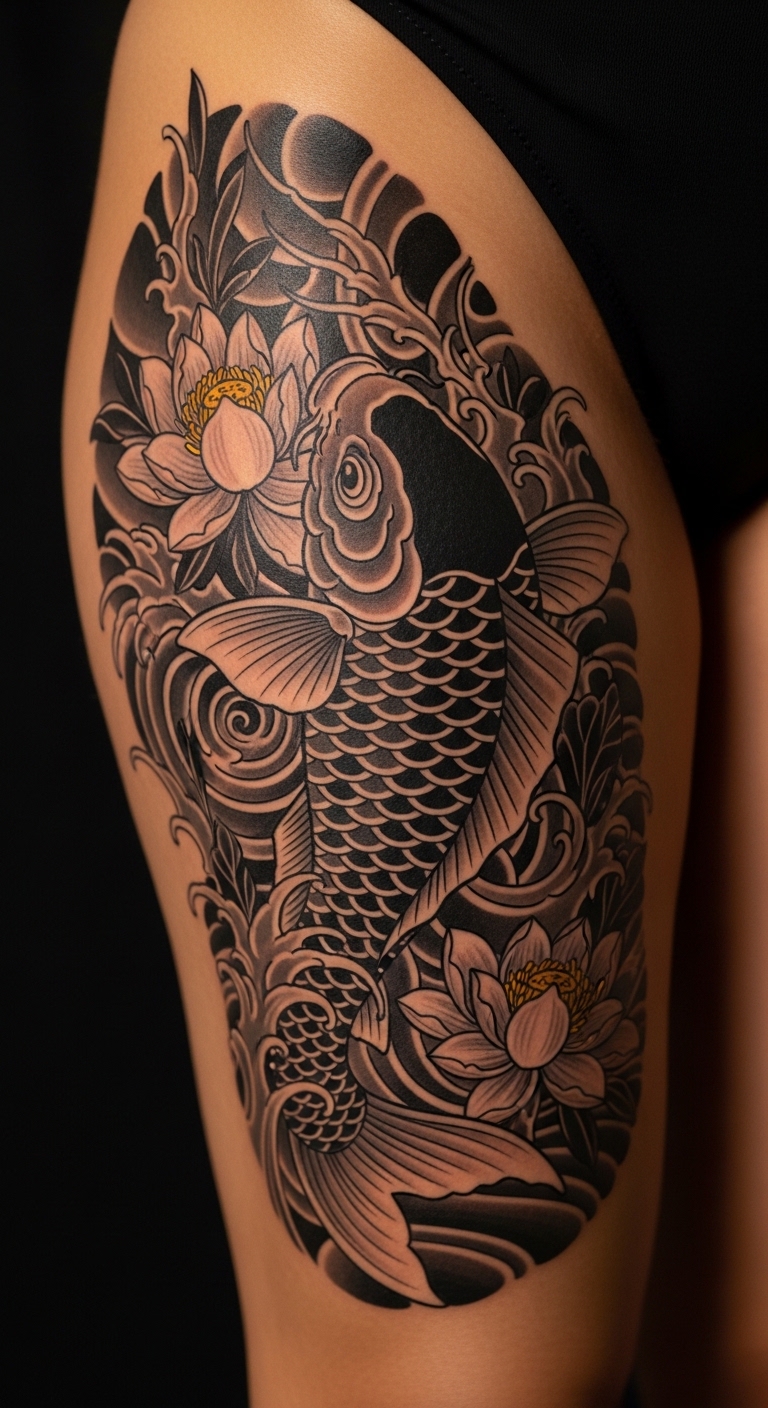
A koi fish swimming upward through blooming lotus flowers on the outer thigh creates a Japanese irezumi composition that layers two of Eastern tattooing’s most powerful symbols into one unified, visually captivating design. The koi’s upward movement through the lotus blooms creates natural compositional energy — the fish pushes through the flowers with determined forward motion while the lotus petals frame the koi’s body with serene, grounded beauty. Moreover, the pairing carries extraordinary symbolic depth — the koi represents perseverance and transformation through effort while the lotus adds spiritual purity, enlightenment, and the beauty of blooming fully despite difficult origins. Additionally, outer thigh canvas suits this vertically oriented paired composition perfectly. Furthermore, Japanese koi and lotus tattoo ideas attract spiritually motivated collectors consistently.
- Koi and lotus create perfect symbolic pairing
- Upward koi movement energizes the composition
- Lotus adds spiritual purity and enlightenment
- Outer thigh canvas suits vertical compositions
- Eastern symbolism resonates across all backgrounds
Outer thigh koi and lotus tattoos require an artist who understands how to balance the visual weight of the koi’s bold body against the lotus flower’s delicate petal structures within a single composition that reads cohesively across the thigh’s surface. Therefore, discussing the specific size relationship between the koi and lotus elements during your consultation ensures the paired design maintains the visual balance that makes this combination so compositionally satisfying. Furthermore, thigh placement heals reliably with loose clothing protecting fresh irezumi linework from friction. Additionally, Japanese koi and lotus thigh tattoos continue generating strong Pinterest saves in 2026 particularly among collectors who want spiritually layered Eastern body art that combines personal transformation symbolism with natural floral beauty in one cohesive, meaningful irezumi composition.
Japanese Tiger Face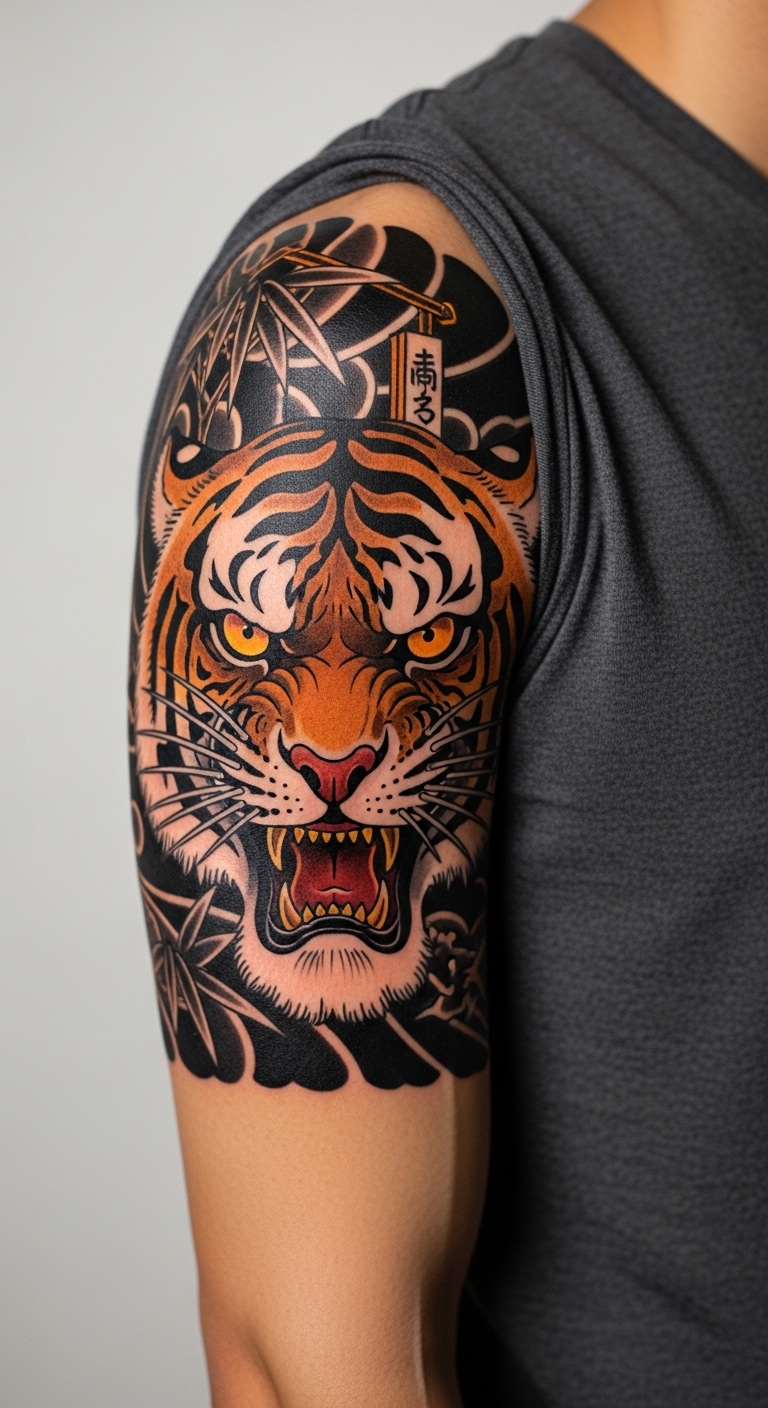
A Japanese tiger face depicted in full forward-facing intensity on the outer upper arm delivers maximum fierce energy in a placement that reveals the design’s powerful expression with every sleeve push-up. The tiger’s bold amber and black striping, fierce golden eyes, and prominent whisker lines create an image that radiates raw protective power with the confident compositional authority of classic Japanese woodblock print tiger portraiture. Moreover, the forward-facing Japanese tiger carries specific symbolic meaning beyond profile compositions — it represents the fierce guardian energy of a creature actively watching over and protecting the person who carries it. Additionally, outer upper arm placement gives the tiger’s face the ideal framing canvas for a forward-facing composition. Furthermore, Japanese tiger tattoo ideas rank consistently among the most searched irezumi designs in 2026.
- Forward tiger face radiates active guardian energy
- Amber stripes create bold visual drama naturally
- Bamboo background adds traditional Japanese context
- Outer arm placement maximizes fierce face visibility
- Protective symbolism resonates with bold collectors deeply
Outer upper arm Japanese tiger face tattoos require an artist with strong Edo period woodblock print tiger reference knowledge because the forward-facing Japanese tiger follows specific artistic conventions — the particular curve of the whisker lines, the shape of the amber eye marking, and the bold stripe pattern distribution — that distinguish authentic irezumi tiger work from generic realistic tiger portraiture. Therefore, sharing Edo period woodblock tiger print references with your artist during consultation ensures your tiger face carries genuine Japanese artistic heritage. Furthermore, upper arm tattoos heal reliably because dense muscle tissue provides excellent ink retention for bold irezumi shading work. Additionally, Japanese tiger face upper arm tattoos continue driving strong Pinterest engagement in 2026 among men aged 21 to 32 who want fierce culturally authentic body art.
Daruma Doll Forearm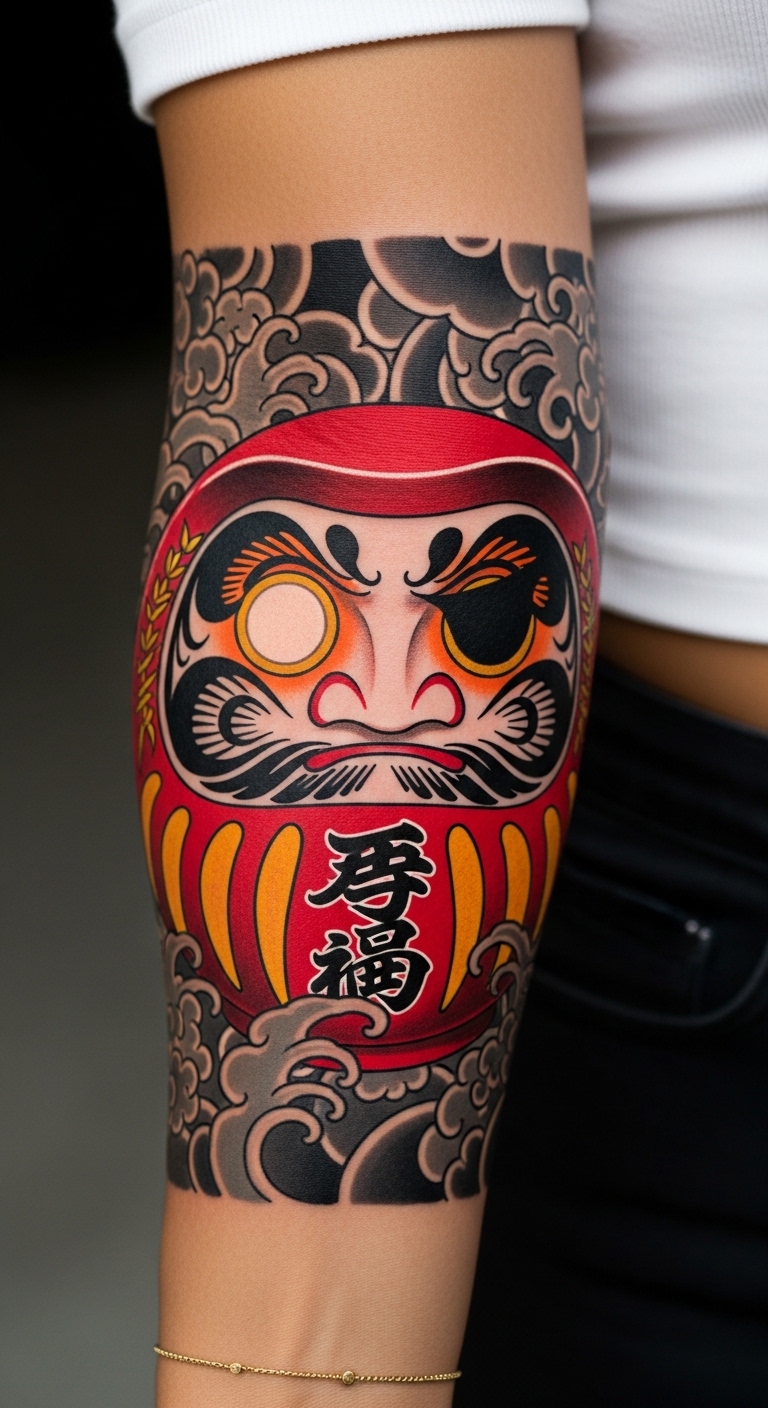
A Japanese Daruma doll tattooed on the inner forearm creates one of traditional Japanese culture’s most personally meaningful and visually striking folk art subjects in a placement that keeps the design’s powerful motivational symbolism in constant daily view. The Daruma’s bold red body, fierce black eyebrows, and one filled-in eye communicate an active, ongoing personal commitment — a goal set, begun, and not yet completed. Moreover, Daruma symbolism in Japanese tradition represents persistence, resilience, and the determination to rise again after every setback — the doll’s weighted base means it always returns upright regardless of how many times it falls. Additionally, inner forearm placement ensures the Daruma’s motivational energy stays visible throughout every daily challenge. Furthermore, Japanese folk art tattoo ideas attract deeply personally motivated collectors.
- Daruma symbolizes unstoppable resilience and persistence
- One eye filled signals active personal commitment
- Bold red body creates immediate visual impact
- Inner forearm keeps motivational symbol visible always
- Folk art aesthetic feels authentically Japanese deeply
Inner forearm Daruma tattoos require an artist who understands the specific visual conventions of Japanese Daruma folk art — the proportional relationship between the head and body, the characteristic eyebrow style, the decorative surface pattern variations, and the bold red color palette that defines authentic Daruma doll iconography. Therefore, referencing traditional Japanese Daruma craft examples with your artist ensures the tattoo captures the genuine folk art quality that distinguishes an authentic irezumi Daruma from a generic cartoon doll illustration. Furthermore, inner forearm tattoos heal predictably because this placement experiences minimal daily friction under most clothing. Additionally, Japanese Daruma forearm tattoos continue gaining momentum on Pinterest in 2026, particularly among collectors who want personally meaningful Japanese cultural body art that reflects an active ongoing commitment to a specific life goal or personal transformation journey.
Tengu Mask Shoulder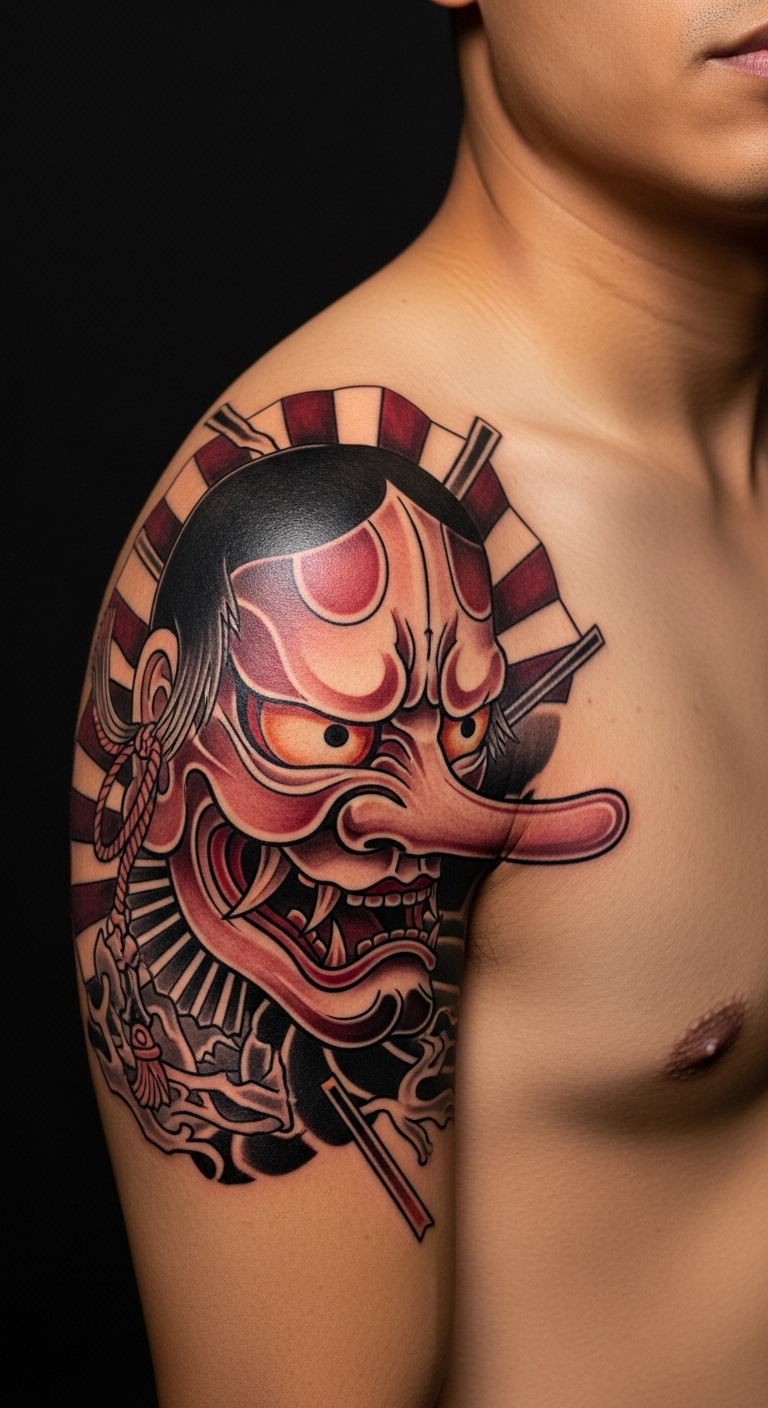
A Japanese Tengu mask tattooed across the outer shoulder creates one of traditional Japanese folklore’s most visually distinctive and symbolically rich subjects in a placement that frames the mask’s dramatic profile with natural muscle architecture. The Tengu’s elongated nose, fierce warrior expression, and elaborate decorative elements create an immediately recognizable design that communicates deep knowledge of Japanese supernatural tradition. Moreover, Tengu symbolism carries complex meaning in Japanese folklore — these supernatural mountain warriors serve as protectors of martial traditions, teachers of warrior arts, and fierce guardians who test worthy humans through challenge rather than destruction. Additionally, shoulder placement suits the Tengu mask’s strong profile orientation perfectly. Furthermore, Japanese mask tattoo ideas attract collectors with serious cultural knowledge and artistic ambition.
- Tengu symbolizes fierce warrior wisdom and testing
- Elongated nose makes design immediately distinctive
- Shoulder muscle frames fierce mask profile naturally
- Red and black palette honors mask tradition
- Supernatural warrior energy suits bold collectors perfectly
Shoulder Tengu mask tattoos require an artist with comprehensive Japanese supernatural mask iconography knowledge because the Tengu’s specific visual elements — the proportional nose length, the karasu-tengu versus yamabushi-tengu style distinctions, and the fan and feather decorative elements — follow artistic conventions established across centuries of Japanese Noh theater mask craft and woodblock print supernatural imagery. Therefore, discussing which specific Tengu variant — the long-nosed dai-tengu or the bird-faced karasu-tengu — you want depicted ensures your artist designs within the correct iconographic tradition for your chosen subject. Furthermore, outer shoulder tattoos heal cleanly with loose clothing draping away during recovery. Additionally, Japanese Tengu mask shoulder tattoos generate strong Pinterest engagement in 2026 particularly among collectors with deep knowledge of Japanese supernatural folklore who want culturally specific body art that communicates genuine scholarly appreciation of the tradition.
Geisha Portrait Arm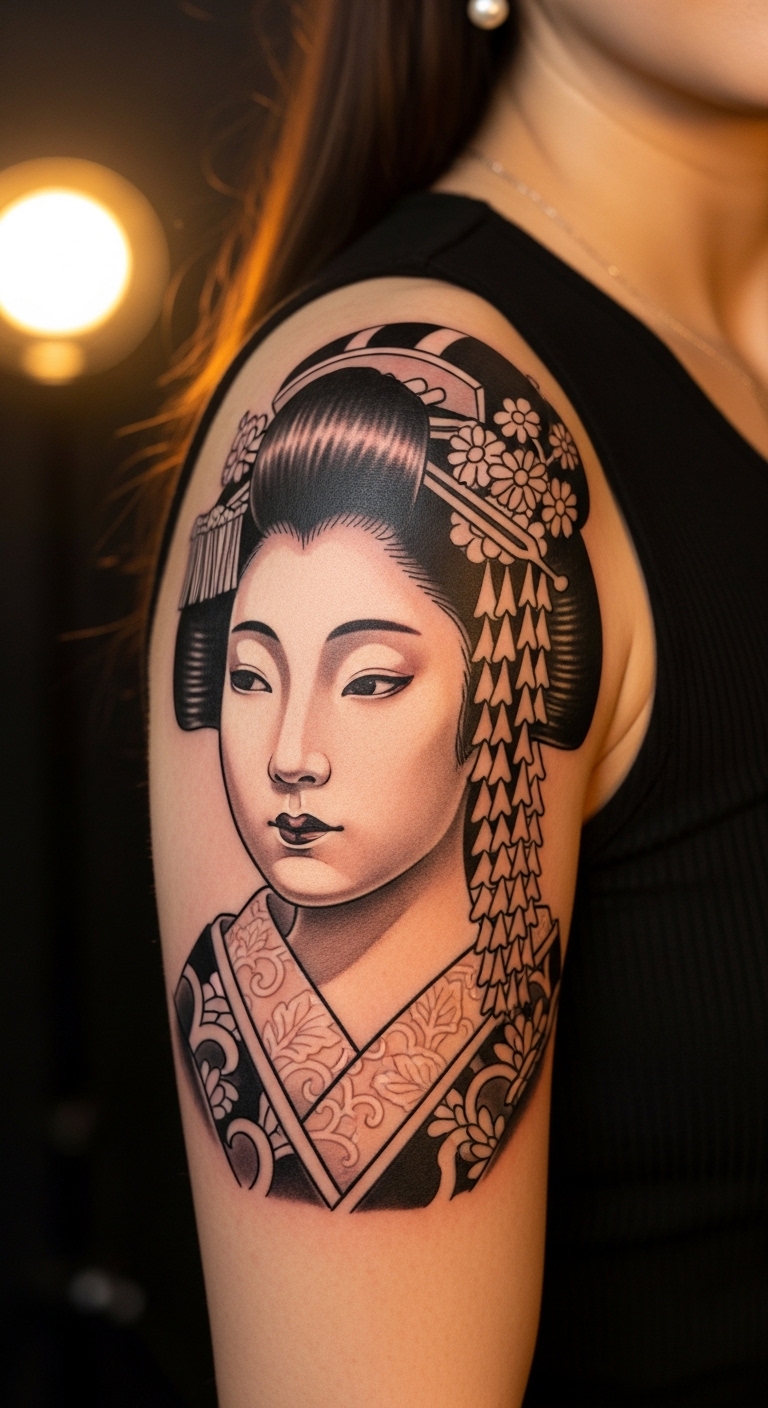
A Japanese geisha portrait on the outer upper arm creates one of traditional irezumi’s most elegant and culturally nuanced figurative subjects in a placement that frames the portrait’s delicate detail with natural visual dignity. The geisha’s white-painted face, elaborate kanzashi hair ornament arrangement, and glimpse of kimono collar create a composition that feels simultaneously intimate and artistically monumental. Moreover, geisha portraiture in Japanese tattooing carries cultural meaning around artistic mastery, disciplined beauty, graceful perseverance through years of dedicated training, and the profound respect given to those who achieve the highest levels of traditional Japanese artistic performance. Additionally, upper arm placement provides a vertically oriented canvas that suits portrait compositions naturally. Furthermore, Japanese figurative tattoo ideas attract collectors who appreciate cultural depth and artistic complexity equally.
- Geisha symbolizes artistic mastery and disciplined grace
- White face paint creates striking monochromatic contrast
- Kanzashi ornaments add elaborate traditional detail
- Portrait composition suits upper arm canvas perfectly
- Irezumi figurative work demands exceptional artist skill
Upper arm Japanese geisha portrait tattoos require an artist with genuine figurative portraiture skills combined with deep irezumi traditional knowledge because the geisha’s face must capture authentic Japanese beauty conventions — the specific kōgao face proportions, the red lip shape, the hairstyle and kanzashi placement — within a bold yet refined black ink rendering style that honors irezumi’s characteristic artistic authority. Therefore, reviewing your artist’s specifically completed Japanese figurative portrait work — not just general portrait tattoos — ensures they understand the cultural conventions that distinguish authentic geisha portraiture from decorative Asian-themed illustration. Furthermore, upper arm geisha portraits heal reliably because dense muscle provides excellent ink retention. Additionally, Japanese geisha arm portraits continue generating strong Pinterest saves in 2026 within feminine irezumi communities that celebrate the intersection of cultural reverence and artistic excellence.
Raijin Thunder God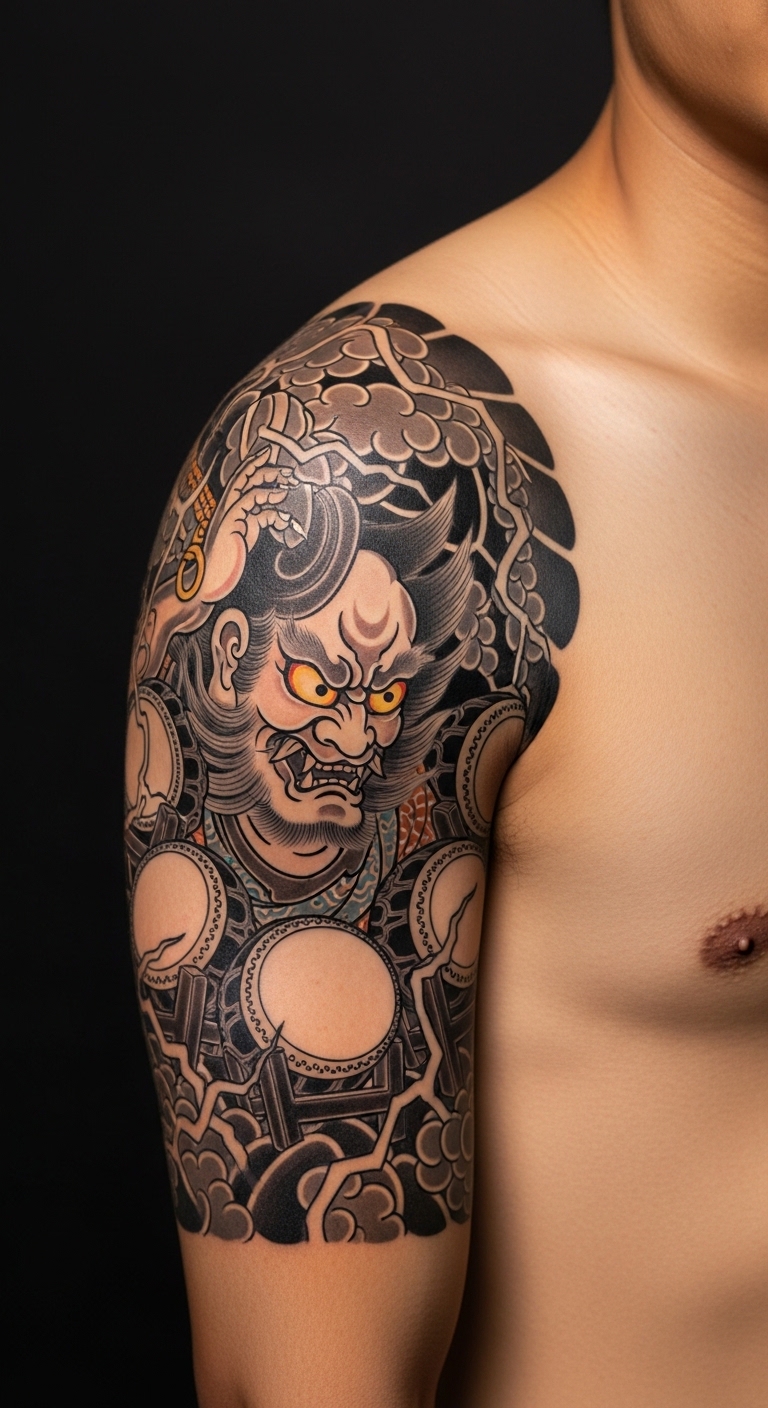
A Japanese Raijin thunder god depicted across the outer upper arm creates one of traditional Japanese mythology’s most dynamically powerful deity subjects in a placement that frames the god’s fierce, energetic form with natural muscle architecture. Raijin’s wild expression, encircling taiko drums, and crackling lightning elements create a composition that radiates raw elemental energy from every viewing angle. Moreover, Raijin symbolism carries extraordinary meaning in Japanese tradition — as the god of thunder, lightning, and storms, Raijin represents the overwhelming creative and destructive power of natural forces that remind humans of their beautiful smallness within the universe’s vast, indifferent energy. Additionally, upper arm placement suits Raijin’s energetic, circular drum composition perfectly. Furthermore, Japanese deity tattoo ideas attract the most culturally committed irezumi collectors globally.
- Raijin symbolizes raw elemental thunder power
- Taiko drum circle creates dynamic visual energy
- Lightning bolts amplify atmospheric compositional drama
- Upper arm frames deity composition powerfully
- Japanese mythology depth rewards cultural knowledge deeply
Upper arm Raijin tattoos require an artist with comprehensive Japanese Shinto deity iconography knowledge because Raijin’s specific visual conventions — the number and arrangement of taiko drums, the specific lightning bolt style, the cloud formation types surrounding the deity figure, and the facial expression conventions — follow artistic traditions established across centuries of Japanese religious painting, woodblock print, and decorative art production. Therefore, studying Edo period Raijin woodblock print imagery with your artist during consultation ensures the deity tattoo honors its mythological heritage with genuine iconographic accuracy. Furthermore, upper arm tattoos heal reliably with dense muscle tissue providing excellent ink retention for dramatic irezumi shading. Additionally, Japanese Raijin deity arm tattoos generate exceptional Pinterest engagement in 2026 among collectors who want epic mythological body art with authentic cultural authority behind every compositional choice.
Fujin Wind God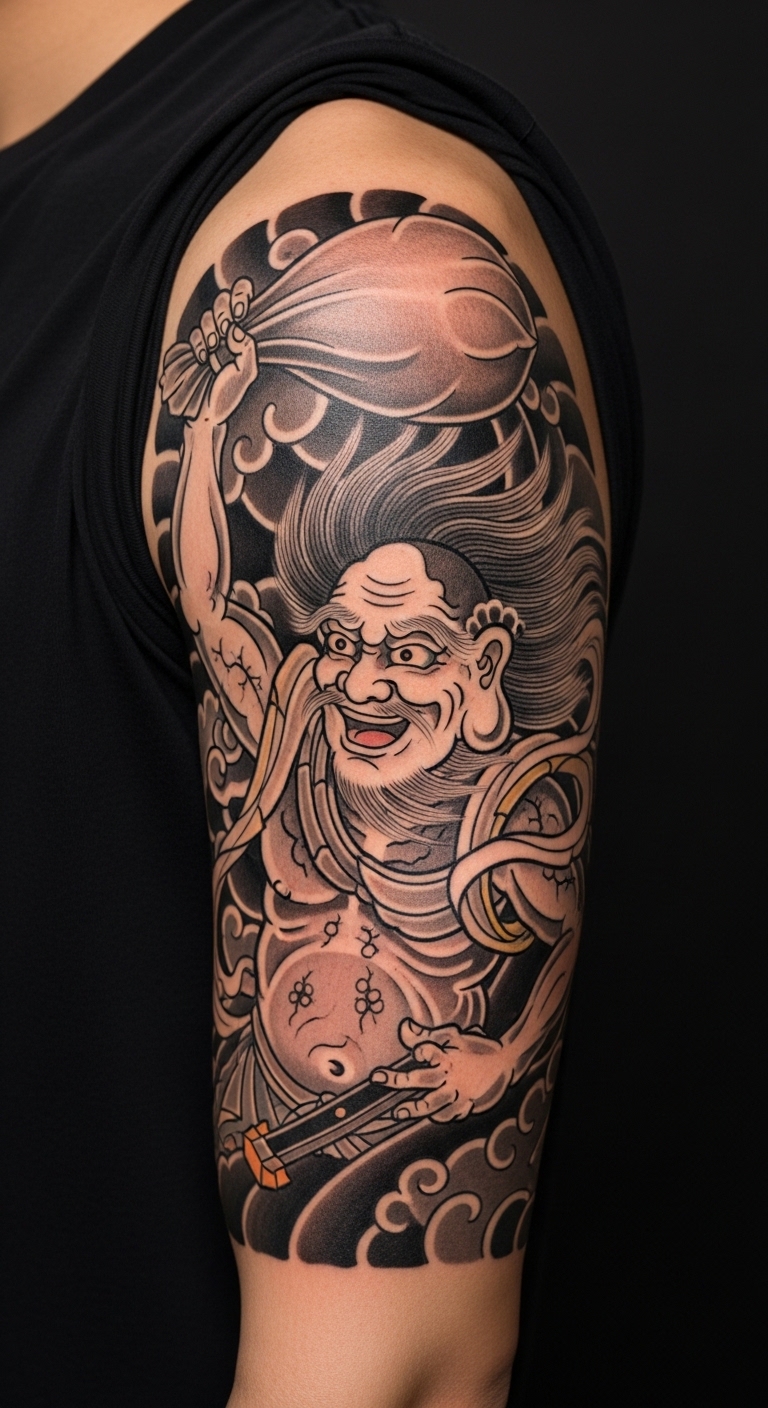
A Japanese Fujin wind god depicted on the outer upper arm creates the perfect companion subject to Raijin, and many serious irezumi collectors choose to pair these two deities across both arms as a traditional matched set. Fujin’s joyful expression, billowing wind bag stretched overhead, and wildly streaming hair create a composition that radiates playful celestial energy entirely distinct from Raijin’s fierce thunder intensity. Moreover, Fujin symbolism in Japanese tradition represents the life-giving force of wind, the freedom of movement across boundless sky, and the divine joy of a deity who spreads breath and animation across every living surface on earth. Additionally, upper arm placement suits Fujin’s dynamic overhead wind bag composition beautifully. Furthermore, Japanese wind god tattoo ideas attract collectors building serious traditional deity collections.
- Fujin symbolizes life-giving wind and joyful freedom
- Wind bag overhead creates upward dynamic movement
- Pairs traditionally with Raijin across both arms
- Wild streaming hair adds natural visual energy
- Deity pairing honors centuries of Japanese tradition
Upper arm Japanese Fujin tattoos require the same level of Shinto deity iconographic expertise as Raijin work because Fujin’s specific visual conventions — the shape and pattern of the wind bag, the hair streaming direction, the cloud and wind bar composition, and the characteristic joyful versus fierce expression distinction from Raijin — all follow established Japanese artistic traditions. Therefore, collectors planning both Raijin and Fujin arm tattoos should work with the same artist across both appointments to ensure visual consistency between the paired deity compositions. Furthermore, upper arm placement heals reliably for both deity tattoos. Additionally, Japanese Fujin wind god arm tattoos generate strong Pinterest engagement in 2026, particularly among collectors building traditional Japanese deity matched sets. I’ve seen paired Raijin and Fujin arm collections described as the most visually cohesive and culturally authentic matched set in all of traditional irezumi tattooing.
Bamboo And Sparrow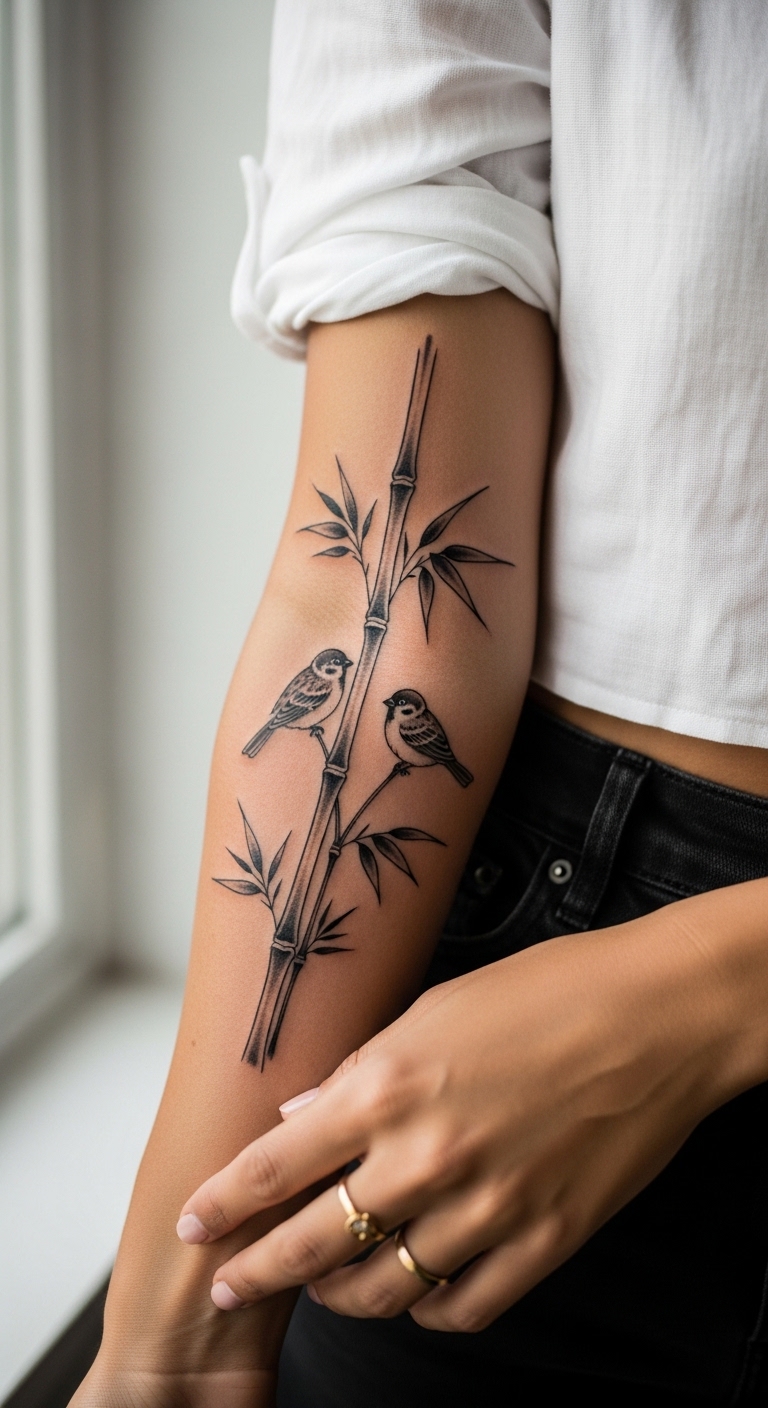
A Japanese bamboo and sparrow composition on the inner forearm creates one of traditional irezumi’s most quietly beautiful and culturally grounded botanical subjects in a placement that displays the design’s delicate vertical structure throughout every daily interaction. The bamboo stalks rise with natural elegance while small suzume sparrows perch between the nodes with the relaxed confidence of creatures completely at home in their natural environment. Moreover, bamboo symbolism in Japanese tradition represents resilience, flexibility, and the remarkable ability to bend dramatically under pressure without breaking — a quality that Japanese culture celebrates as one of the most admirable characteristics a person can embody. Additionally, the sparrow adds companionship, everyday joy, and the beauty of finding contentment in simple natural surroundings. Furthermore, Japanese botanical tattoo ideas suit collectors who prefer quiet elegance over bold statement pieces.
- Bamboo symbolizes resilience and graceful flexibility
- Sparrows add companionship and everyday natural joy
- Vertical structure suits inner forearm naturally
- Botanical irezumi feels quietly elegant and refined
- Delicate linework rewards close personal inspection always
Inner forearm Japanese bamboo and sparrow tattoos require an artist with strong Japanese botanical illustration knowledge because the bamboo’s specific node spacing, culm proportions, and leaf arrangement follow natural botanical accuracy conventions that distinguish authentic Japanese bamboo art from decorative bamboo motifs. Furthermore, the suzume sparrow’s perching posture, feather detail level, and positional relationship to the bamboo stalks must feel naturally observed rather than artificially posed to achieve the calm, living quality that makes Japanese botanical tattoo compositions so genuinely moving. Therefore, studying Edo period Japanese botanical woodblock prints with your artist ensures the composition captures authentic natural observation. Additionally, Japanese bamboo and sparrow forearm tattoos continue gaining strong Pinterest traction in 2026 among collectors who want refined, culturally grounded irezumi work with quiet symbolic depth.
Maple Leaf Back Scatter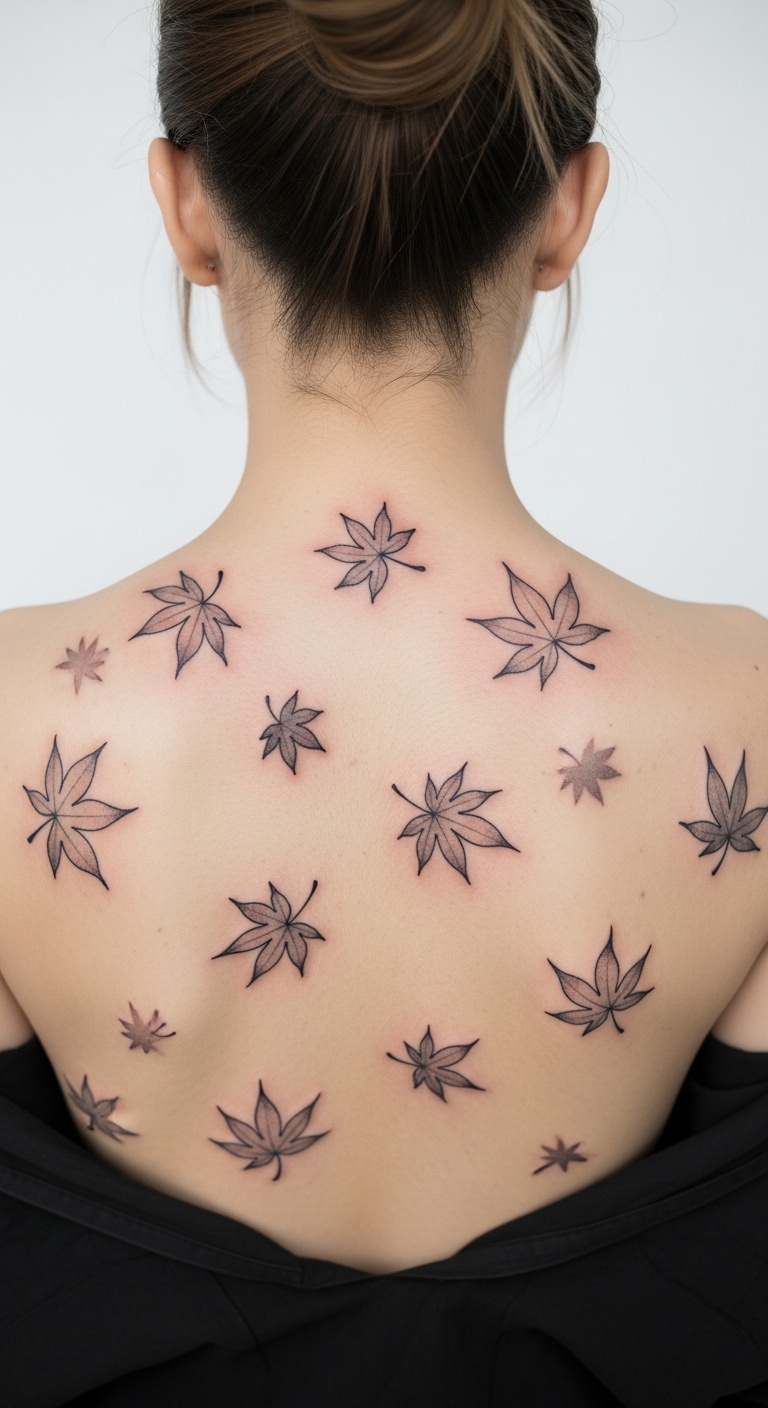
Japanese momiji maple leaves scattered naturally across the upper back create a tattoo that captures the fleeting, melancholy beauty of autumn impermanence in one of traditional irezumi’s most poetically graceful botanical compositions. Each leaf falls at a slightly different angle and scale, creating a composition that feels genuinely observed from a single perfect autumn afternoon rather than artificially arranged on a design sheet. Moreover, momiji symbolism in Japanese tradition connects directly to the mono no aware philosophy — the profound bittersweet appreciation of beauty specifically because it passes, and the deep emotional richness that comes from fully experiencing each season’s gifts before they disappear. Additionally, upper back placement gives scattered maple leaves the open canvas they need to distribute naturally. Furthermore, Japanese autumn tattoo ideas attract deeply philosophical collectors.
- Momiji symbolizes autumn beauty and impermanence
- Scattered leaves create naturally observed composition
- Varying angles add organic spontaneous movement
- Upper back canvas suits scattered botanical designs
- Philosophical depth resonates with thoughtful collectors deeply
Upper back Japanese maple leaf scatter tattoos require an artist with strong Japanese botanical composition skills because the organic distribution of scattered leaves must feel genuinely random and naturally observed rather than mechanically spaced across the back’s surface. Therefore, giving your artist complete creative freedom over the specific scatter distribution — while guiding the overall density and coverage zone — produces a more naturally beautiful result than specifying exact leaf positions during consultation. Furthermore, upper back tattoos heal smoothly with loose breathable tops during the 2-week recovery period. Additionally, Japanese momiji maple leaf back tattoos continue generating strong Pinterest saves in 2026 among collectors drawn to quiet, philosophical Japanese botanical body art that communicates cultural depth through restrained, elegant natural observation rather than bold dramatic subject matter.
Namakubi Severed Head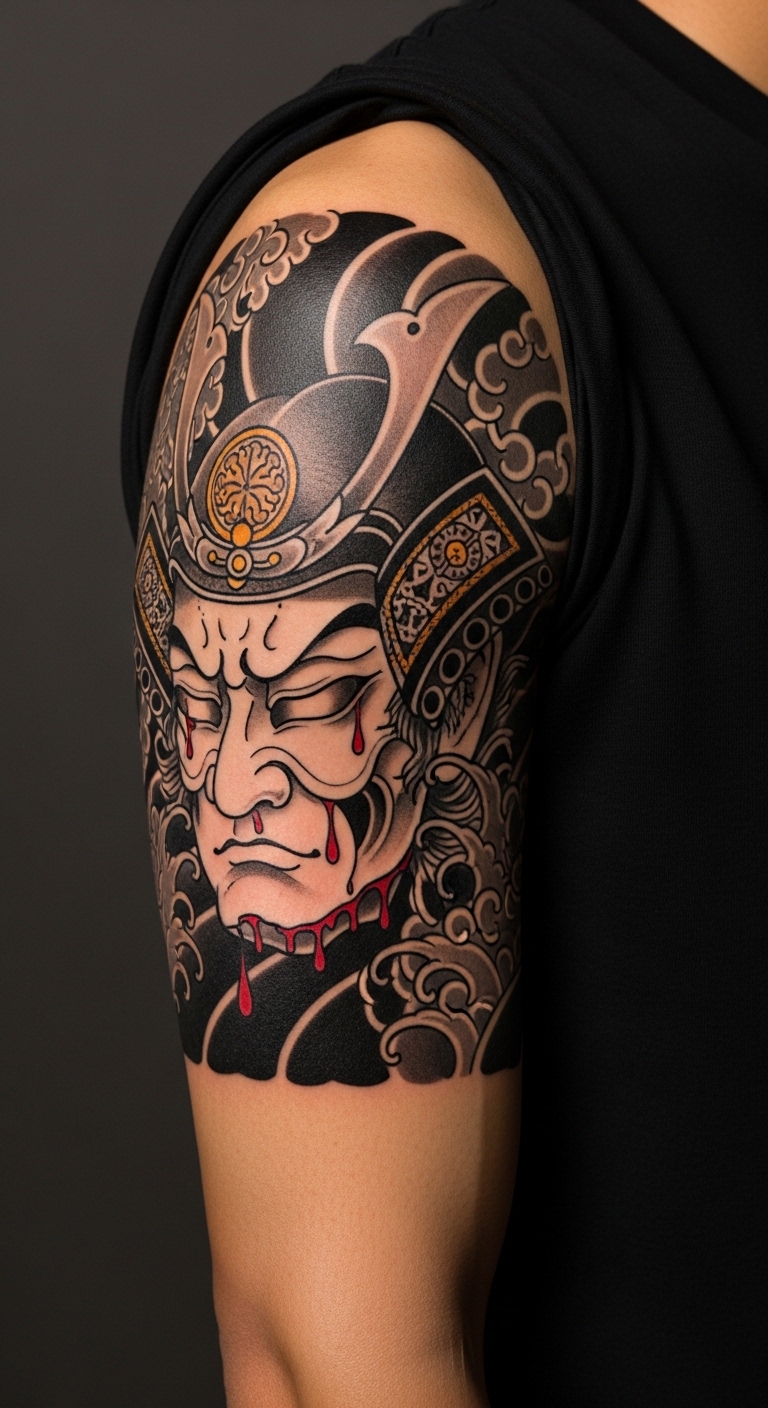
A Japanese namakubi on the outer upper arm creates one of traditional irezumi’s most confrontationally powerful and philosophically complex subjects — a severed samurai head depicted with an expression of absolute serenity rather than fear or agony. The paradox of the namakubi’s calm expression amidst visceral imagery communicates a philosophical message that serious Japanese tattoo tradition has carried for centuries. Moreover, namakubi symbolism in irezumi tradition does not represent violence or morbidity — instead it honors the samurai concept of facing death with complete equanimity, the ultimate expression of courage that transforms the most terrifying human experience into a moment of profound spiritual peace. Additionally, upper arm placement frames the namakubi’s powerful frontal portrait with natural muscle architecture. Furthermore, traditional Japanese philosophical tattoo ideas attract the most intellectually serious irezumi collectors.
- Namakubi symbolizes facing death with perfect equanimity
- Serene expression transforms confrontation into philosophy
- Blood elements honor authentic irezumi visual tradition
- Upper arm frames powerful portrait composition naturally
- Deep philosophical meaning rewards cultural understanding profoundly
Upper arm namakubi tattoos require an artist with specific knowledge of traditional Japanese decapitated head iconography because the namakubi’s serene facial expression conventions, blood presentation style, and decorative border elements all follow visual traditions established in Edo period woodblock prints and established irezumi artistic practice across generations of Japanese tattoo masters. Therefore, understanding the philosophical meaning of the namakubi before booking ensures you approach this design from a place of genuine cultural respect and intellectual appreciation rather than purely aesthetic interest. Furthermore, upper arm placement heals reliably for this bold irezumi work. Additionally, Japanese namakubi arm tattoos generate strong Pinterest engagement in 2026 among collectors with serious knowledge of traditional Japanese tattoo culture who want body art that communicates genuine philosophical depth and authentic cultural engagement. I’ve seen namakubi collectors describe this design as their most intellectually meaningful tattoo choice.
Taiko Drum Calf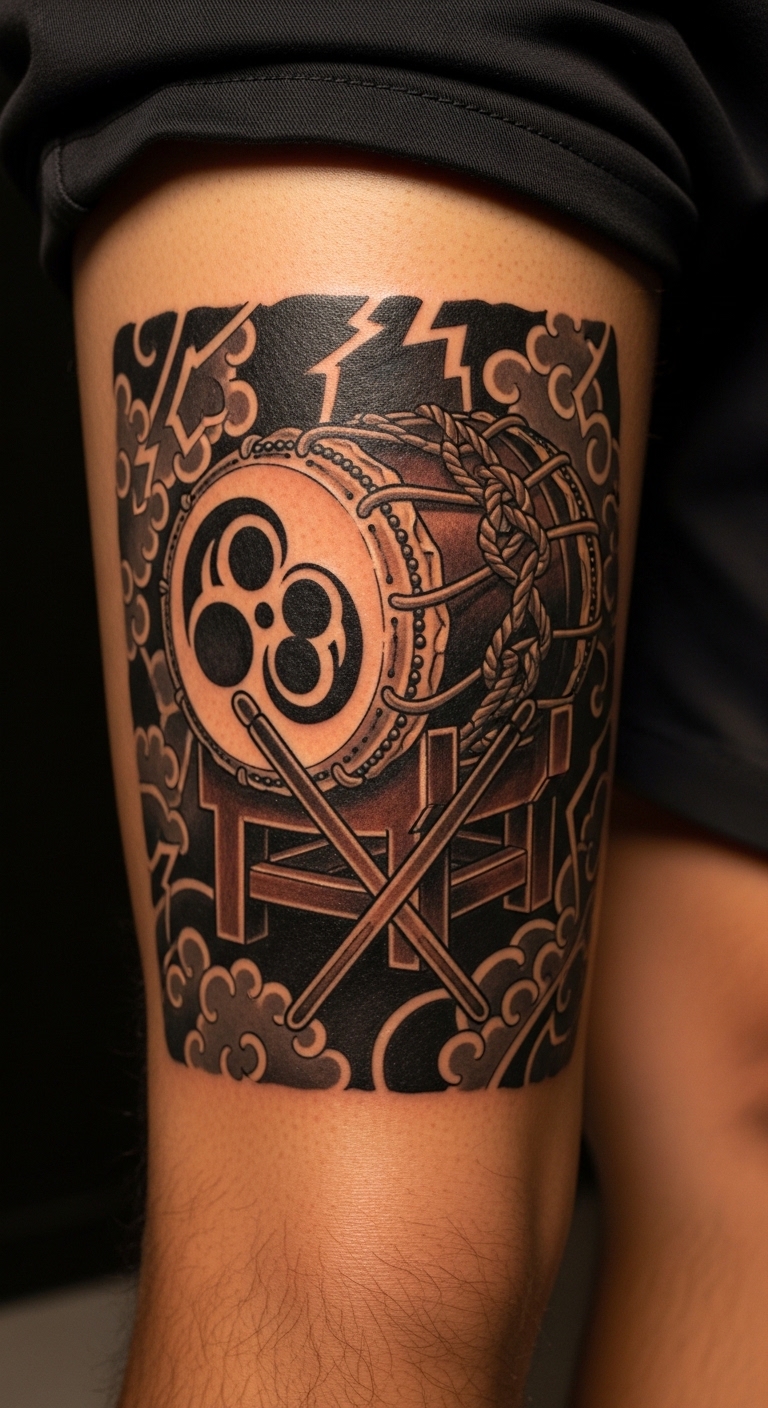
A Japanese taiko drum depicted on the outer calf creates a bold cultural tribute to one of Japan’s most powerful and communally meaningful musical traditions in a placement that suits the design’s strong vertical proportions perfectly. The taiko drum’s decorated barrel body, traditional rope lacing pattern, and crossed bachi drumsticks create a composition that radiates rhythmic energy and communal celebration from a single static image. Moreover, taiko symbolism in Japanese tradition carries meaning around community strength, the heartbeat rhythm that unites people in shared purpose, and the thunderous power of collective human energy expressed through percussion. Additionally, outer calf placement gives the taiko drum’s vertically proportioned composition natural room to display the full drum and stick arrangement clearly. Furthermore, Japanese cultural object tattoo ideas attract collectors with deep appreciation for traditional Japanese arts.
- Taiko symbolizes community strength and shared rhythm
- Rope lacing detail requires exceptional linework precision
- Crossed bachi sticks add dynamic compositional energy
- Outer calf suits vertical drum proportions naturally
- Cultural tribute honors Japanese percussion tradition deeply
Outer calf Japanese taiko drum tattoos require an artist with strong knowledge of traditional Japanese drum iconography because the specific rope lacing pattern variations, the decorative circular drum face design, and the bachi drumstick style all follow visual conventions established in Japanese festival art, woodblock prints, and decorative craft traditions. Therefore, referencing authentic taiko drum photography and traditional Japanese festival imagery with your artist during consultation ensures the drum tattoo captures genuine cultural authenticity. Furthermore, outer calf tattoos heal smoothly with loose clothing sitting away from the calf surface during daily activity. Additionally, Japanese taiko drum calf tattoos continue gaining momentum on Pinterest in 2026 among collectors who want culturally specific Japanese body art that celebrates traditional performing arts rather than supernatural or warrior subject matter.
Kabuki Actor Face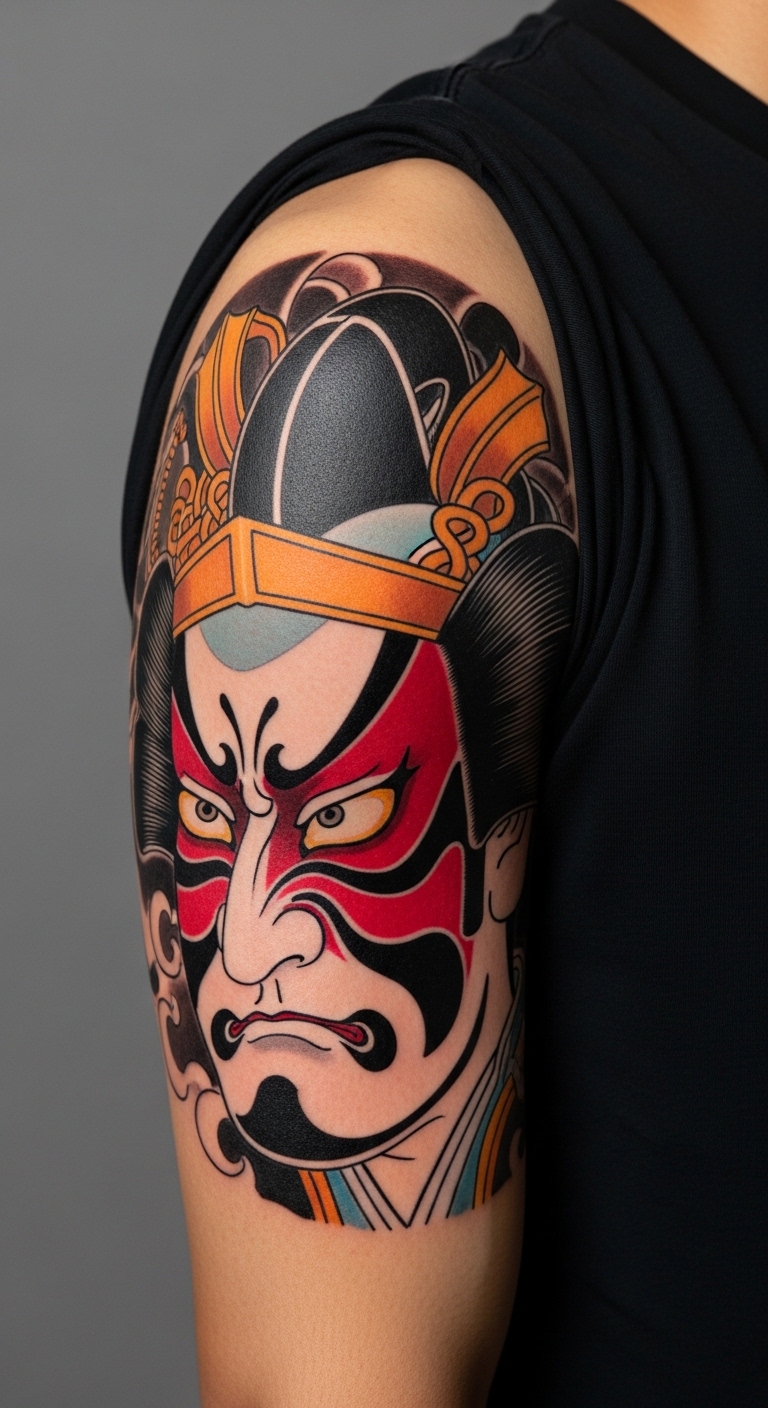
A Japanese kabuki actor face depicted with full kumadori dramatic face paint on the outer upper arm creates one of traditional Japanese performing arts’ most visually spectacular subjects in a placement that frames the actor’s theatrical expression with natural visual authority. The kumadori paint lines — bold red and black patterns radiating from eyes and cheeks — create a design that reads with extraordinary visual intensity even from a significant distance. Moreover, kabuki symbolism in Japanese tattoo tradition carries meaning around theatrical power, the art of transforming completely into a role, and the cultural reverence Japan holds for its living national theatrical traditions. Additionally, upper arm placement suits the kabuki portrait’s strong frontal orientation naturally. Furthermore, Japanese performing arts tattoo ideas attract collectors with sophisticated cultural interests.
- Kabuki symbolizes theatrical transformation and cultural reverence
- Kumadori face paint creates immediate visual intensity
- Red and black lines read powerfully from distance
- Upper arm frames theatrical portrait naturally
- Performing arts tribute honors living Japanese culture
Upper arm Japanese kabuki actor tattoos require an artist with specific kumadori face paint knowledge because the specific line pattern, color zone distribution, and facial proportion conventions of kabuki makeup follow theatrical traditions that differ significantly between different kabuki role types — aragoto warrior roles use different kumadori patterns than wagoto romantic roles. Therefore, discussing which specific kabuki role and kumadori style you want depicted with your artist ensures the tattoo represents a specific theatrical tradition authentically. Furthermore, upper arm tattoos heal reliably for detailed irezumi portrait work. Additionally, Japanese kabuki face arm tattoos continue generating strong Pinterest engagement in 2026, particularly among collectors who want Japanese cultural body art that celebrates traditional performing arts rather than supernatural or warrior themes. I’ve seen kabuki face tattoos consistently attract the most culturally sophisticated collector communities in irezumi tattooing.
Japanese Carp Ankle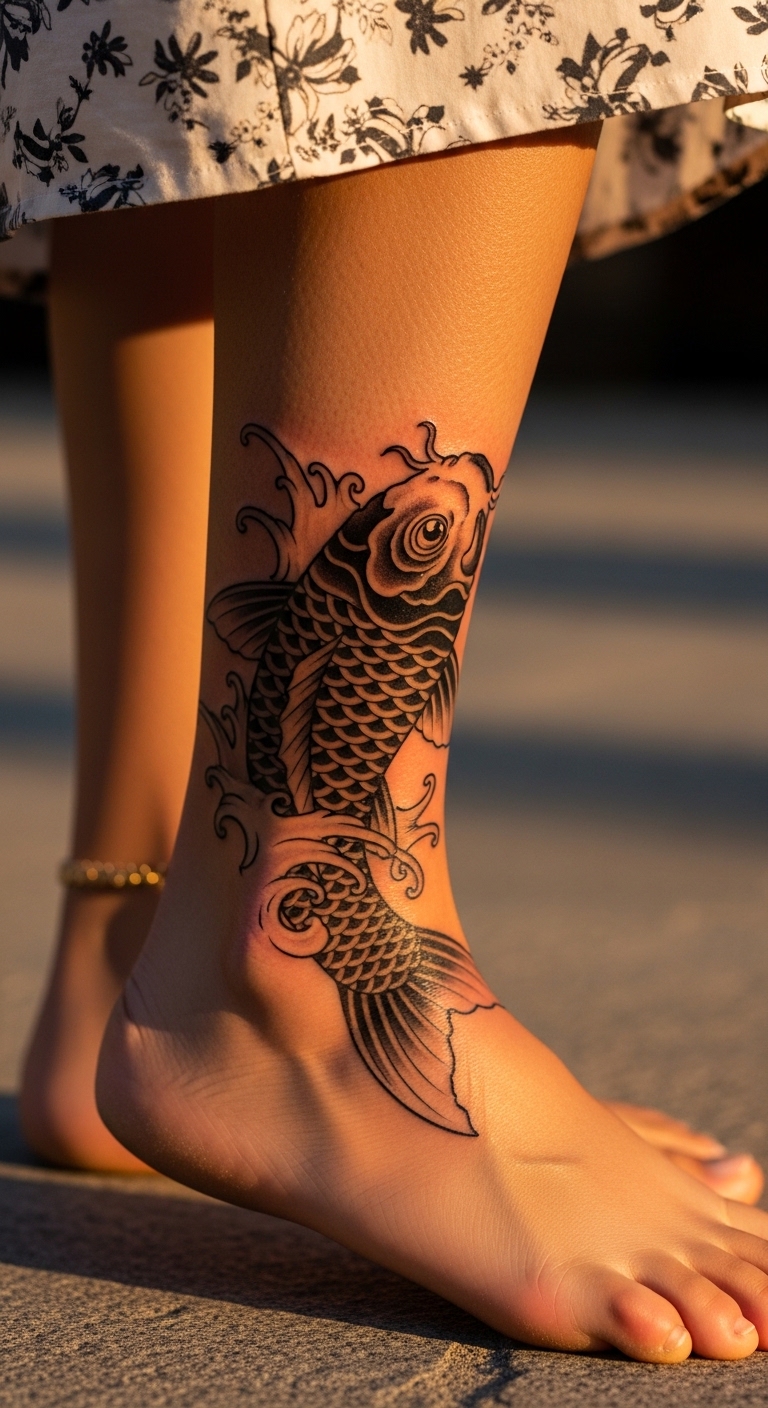
A Japanese koi carp wrapping naturally around the ankle creates a compact but symbolically complete irezumi design that brings the full power of carp perseverance symbolism to one of the body’s most charming and unexpected placements. The carp’s scaled body follows the ankle’s natural circular form, with flowing fins extending slightly above and below the wrap to create organic movement within the compact composition. Moreover, this ankle placement suits collectors who want traditional Japanese tattoo symbolism in a design that reveals itself naturally during warmer months in sandals and bare feet, staying completely hidden under socks and boots during professional daily activity. Additionally, the ankle carp suits collectors at every irezumi experience level. Furthermore, Japanese koi tattoo ideas in compact ankle format generate strong Pinterest engagement specifically among feminine irezumi audiences.
- Compact koi brings full perseverance symbolism
- Ankle wrap follows circular form naturally
- Flowing fins extend beyond wrap gracefully
- Hidden under socks for professional settings
- Feminine irezumi placement feels charming and bold
Ankle Japanese carp tattoos require an artist who understands how to adapt traditional irezumi koi compositions to a significantly reduced scale without losing the characteristic scale detail, fin movement, and water ripple elements that define authentic Japanese carp tattooing. Therefore, working with an artist who has specifically completed compact irezumi wraps — rather than simply scaling down large sleeve compositions — ensures the ankle carp retains its cultural authenticity and visual quality at the smaller format. Furthermore, ankle tattoos experience higher fading rates from footwear friction and daily activity, making SPF application and periodic touch-ups important long-term maintenance commitments. Additionally, Japanese carp ankle tattoos continue performing strongly on Pinterest in 2026. I’ve seen this compact irezumi placement generate particularly warm responses from collectors discovering traditional Japanese tattooing for the first time.
Mt Fuji Watercolor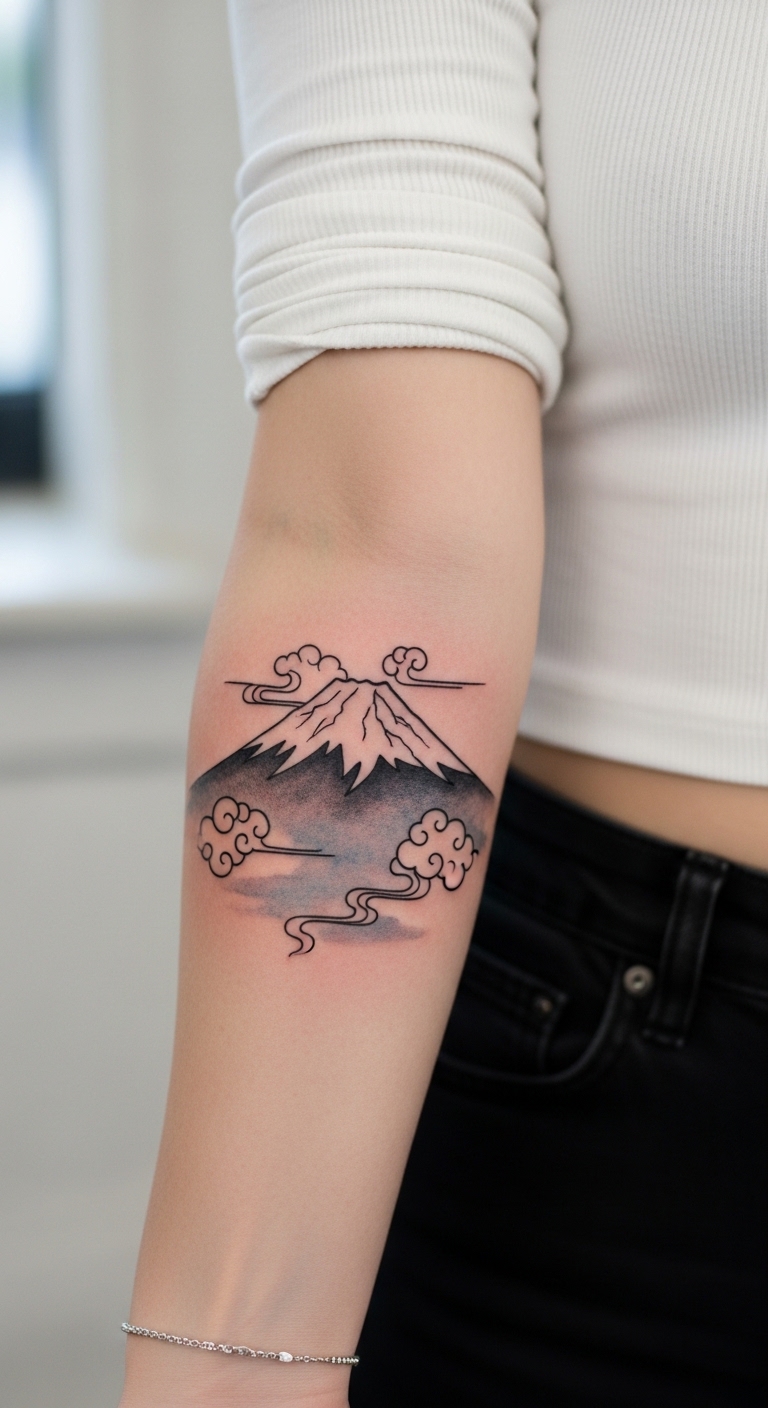
A Japanese Mt. Fuji silhouette with soft indigo watercolor wash and traditional irezumi cloud elements on the inner forearm creates a tattoo that combines Japan’s most sacred geographical symbol with a contemporary color technique in one quietly breathtaking design. The mountain’s clean outline rises above a wash of soft blue and gray tones that suggest early morning mist rising from the volcanic slopes below the summit snowcap. Moreover, Mt. Fuji symbolism carries profound meaning in Japanese cultural tradition — as Japan’s highest mountain and a sacred site of Shinto and Buddhist pilgrimage, Fuji represents aspiration, perseverance, the rewards of patient effort, and the sublime beauty of natural perfection. Additionally, inner forearm placement keeps this culturally significant landmark in constant daily view. Furthermore, Japanese landscape tattoo ideas attract culturally inspired collectors deeply.
- Mt. Fuji symbolizes aspiration and natural perfection
- Watercolor wash adds contemporary color softness
- Sacred pilgrimage symbolism runs culturally deep
- Inner forearm keeps landmark symbol visible daily
- Traditional outline meets modern wash technique beautifully
Inner forearm Mt. Fuji watercolor tattoos require an artist who understands both traditional Japanese irezumi outline conventions and contemporary watercolor wash techniques because the design bridges two distinct tattooing approaches that demand different technical skill sets within a single composition. Therefore, reviewing your artist’s specifically completed Japanese landscape work with watercolor elements — rather than purely traditional or purely watercolor portfolio pieces separately — ensures they can execute the hybrid technique with genuine mastery. Furthermore, inner forearm placement heals predictably for this delicate combined technique work. Additionally, Japanese Mt. Fuji watercolor forearm tattoos continue generating strong Pinterest saves in 2026 among collectors who want culturally meaningful Japanese landscape body art that feels both traditionally grounded and aesthetically contemporary. I’ve seen this design resonate most powerfully with collectors who have visited or feel deeply connected to Japan personally.
Japanese Skull Flowers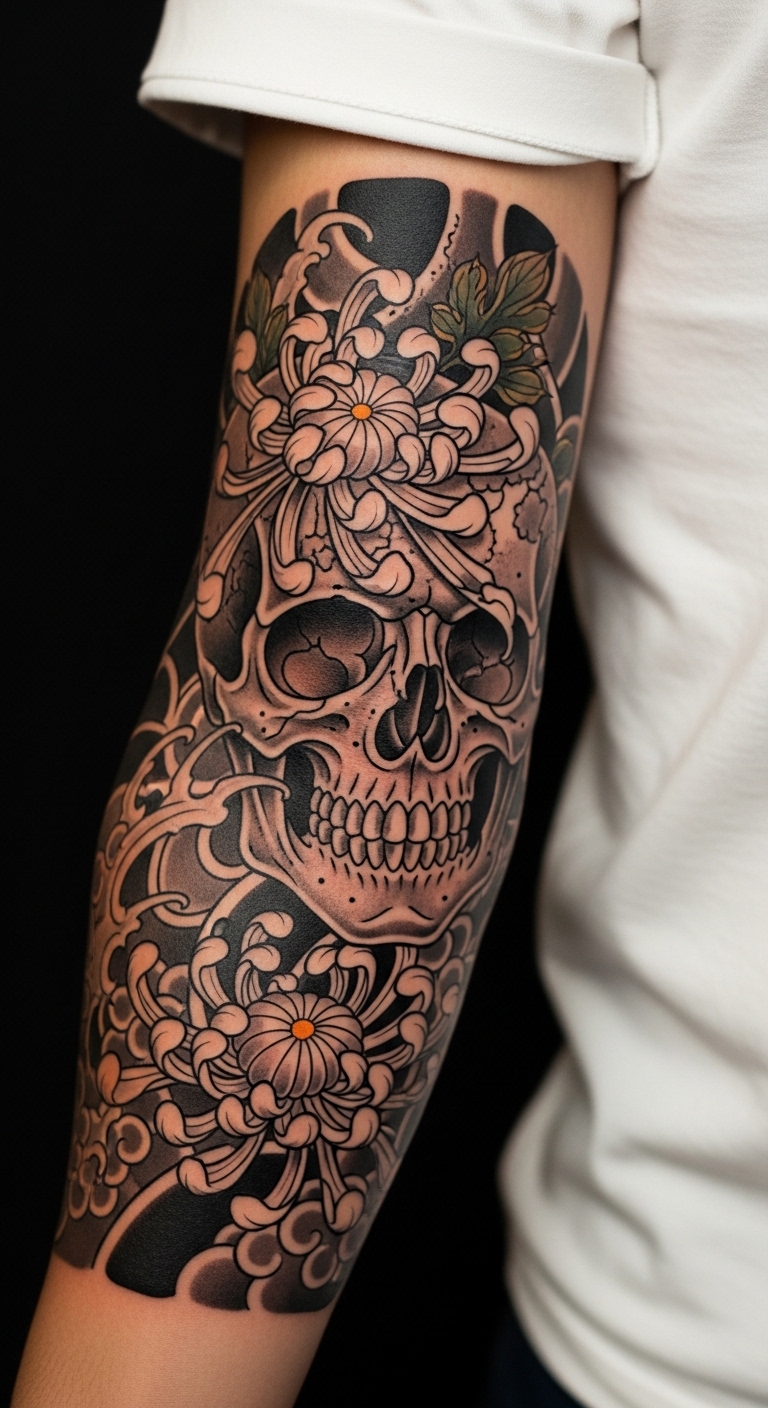
A Japanese skull with chrysanthemum flowers growing through and around its structure creates one of traditional irezumi’s most philosophically resonant compositional pairings — the hard permanence of bone meeting the soft, recurring beauty of Japan’s most imperial flower. The chrysanthemum blooms push through the skull’s eye sockets and crown with natural, unstoppable vitality, creating a visual argument that beauty and life always find their way through even the most permanent-seeming obstacles. Moreover, this pairing in Japanese tattoo tradition carries layered meaning around the coexistence of death and beauty, the Buddhist concept of impermanence, and the remarkable human capacity to find and create beauty even while fully acknowledging mortality’s absolute certainty. Additionally, outer forearm placement keeps this philosophically rich design visible. Furthermore, Japanese skull tattoo ideas attract deeply thoughtful collectors consistently.
- Skull and chrysanthemum symbolize death meeting beauty
- Flowers growing through bone creates powerful visual argument
- Buddhist impermanence philosophy runs deeply meaningful
- Outer forearm keeps philosophical design visible always
- Bold irezumi pairing rewards cultural understanding deeply
Outer forearm Japanese skull and chrysanthemum tattoos require an artist with strong knowledge of both Japanese skull iconography and botan chrysanthemum botanical conventions because each element must maintain its individual artistic integrity while interacting compositionally with the other in a way that feels visually unified rather than simply overlapping. Therefore, discussing the specific interaction points between the skull and chrysanthemum elements — which flowers emerge from which skull openings, how the stems weave through the bone structure — with your artist during consultation produces the most intentional and philosophically coherent final composition. Furthermore, outer forearm tattoos experience consistent daily sun exposure, making SPF 50 application after healing an important long-term maintenance habit. Additionally, Japanese skull and chrysanthemum forearm tattoos continue driving strong Pinterest engagement in 2026 among collectors drawn to traditional irezumi’s extraordinary capacity for philosophical depth expressed through bold, beautiful visual storytelling.
Conclusion
Every Japanese irezumi tattoo idea in this article proves that traditional body art carries extraordinary depth when it draws from centuries of genuine cultural meaning. Bold dragons, sacred deities, philosophical masks, and poetic botanical compositions all communicate something that purely decorative tattoos simply cannot reach. Moreover, Japanese irezumi tattoo ideas give collectors body art that grows more meaningful with every passing year rather than simply aging on skin. Save this post on Pinterest right now, share it with a friend planning their irezumi journey, and take that inspired first step toward a traditional Japanese tattoo you will carry with genuine pride every single day. I’ve seen irezumi completely transform how collectors understand their own bodies as meaningful artistic canvases.
Frequently Asked Questions
What does irezumi mean in Japanese?
Irezumi literally means “inserting ink” in Japanese. It refers specifically to traditional Japanese tattooing using hand-poked or machine needle techniques following classical Japanese compositional and iconographic conventions developed across centuries of Japanese artistic tradition.
How long does a Japanese irezumi tattoo take?
Small irezumi pieces take 2 to 4 hours. Medium arm or thigh compositions require 5 to 15 hours across multiple sessions. Full back or sleeve irezumi pieces typically require 25 to 50 hours across 6 to 15 sessions spanning 1 to 3 years.
Are Japanese irezumi tattoos culturally appropriate for non-Japanese collectors?
Most Japanese tattoo artists actively welcome non-Japanese collectors who approach irezumi with genuine cultural respect and symbolic understanding. Learning the meaning behind your chosen subject before booking demonstrates the respect that irezumi artists and the tradition genuinely deserve.
What is the most painful irezumi placement?
The spine, ribs, sternum, and inner elbow rank as the most painful irezumi placements. Outer arms, thighs, and upper back offer significantly more comfort. Pain level depends on individual tolerance, placement, and session length rather than the irezumi style itself.
How do I find a genuine irezumi specialist?
Search specifically for artists who list traditional Japanese tattooing as their primary specialty. Review their healed portfolio — not just fresh work. Look for authentic compositional conventions in their designs. Genuine irezumi specialists typically have long waiting lists because serious collectors actively seek their expertise.
How much does a Japanese irezumi sleeve cost?
A full irezumi sleeve typically costs between $3,000 and $8,000 or more depending on artist experience, studio location, and total design complexity. Specialist irezumi artists charge premium rates that reflect decades of cultural study and technical mastery. Quality irezumi represents a serious long-term financial investment.